Catch tolerance drift before it's too late. Try MDCplus
Try it yourself Get guided demo17 February 2026
Why CNC Parts Go Out of Tolerance During Machining - Causes and Fixes
This guide explains the most common reasons CNC parts go out of tolerance during production and what you can do to prevent it.
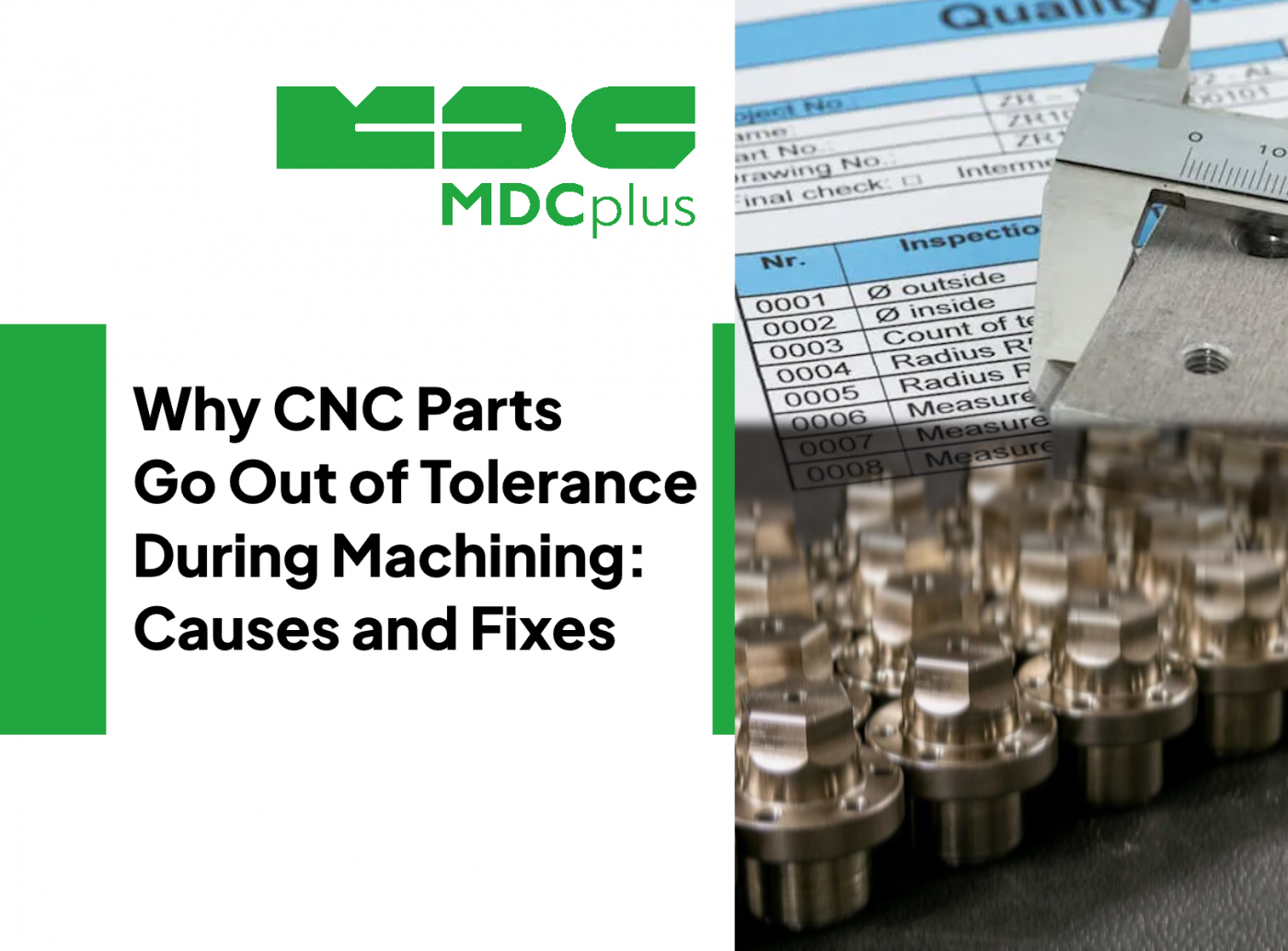
When CNC parts start drifting out of tolerance during a production run, it is rarely random. Dimensional variation mid-run usually signals instability in tooling, thermal behavior, machine condition, or process control. Unlike catastrophic tool breakage, tolerance drift is subtle — and more expensive over time because it produces hidden scrap before anyone reacts.
1. Tool Wear Progression (Gradual Dimensional Drift)
What Happens
As cutting tools wear, cutting forces increase and geometry changes. The tool effectively becomes smaller (in milling) or loses sharpness (in turning), causing dimensions to drift gradually.
Real Scenario
A batch of 304 stainless components starts within tolerance. After 60 parts, bore diameter begins increasing by 0.02 mm. No breakage occurs — only progressive wear on the insert.
How to Fix It
Define tool life based on measured wear, not guesswork. Implement in-process probing or scheduled offsets. Monitor spindle load trends to detect increasing cutting forces before parts go out of spec.
2. Thermal Growth (Machine and Workpiece Expansion)
What Happens
Spindles, ball screws, and even the machine casting expand as temperature rises during production. Workpieces also grow during heavy roughing. Thermal growth shifts dimensional reference.
Real Scenario
First parts of the shift are undersized. After 2 hours of continuous machining, diameters increase consistently. The machine stabilizes once thermal equilibrium is reached.
How to Fix It
Warm up the machine before tight tolerance work. Use thermal compensation if available. Maintain stable ambient temperature. For high precision, implement probing cycles mid-run.
3. Tool Deflection Under Load
What Happens
Long stick-out tools bend under cutting pressure. As material engagement changes, deflection increases, shifting part geometry.
Real Scenario
A deep pocket requires 80 mm stick-out. Early parts are correct. Later in the run, as tool dulls and forces rise, wall thickness begins drifting.
How to Fix It
Reduce stick-out. Use variable flute or reinforced tools. Lower radial engagement. Switch to adaptive toolpaths to stabilize cutting forces.
4. Fixture Instability or Clamping Variation
What Happens
As fixtures heat up or operators re-clamp inconsistently, part position shifts slightly between cycles.
Real Scenario
Thin aluminum plate shows flatness variation increasing over the shift. Root cause: fixture expansion and uneven torque on clamps.
How to Fix It
Standardize clamping torque. Inspect fixture wear. Consider hydraulic or zero-point systems for repeatability.
5. Built-Up Edge (Especially in Aluminum)
What Happens
Material adheres to the cutting edge, altering effective tool diameter and producing inconsistent dimensions.
Real Scenario
High-speed aluminum milling shows sudden dimensional variation without visible wear. Inspection reveals material welding to the tool.
How to Fix It
Increase cutting speed slightly. Use polished aluminum-specific tooling. Improve coolant flow or air blast.
6. Machine Wear or Axis Backlash
What Happens
Worn ball screws or guideways create positional inconsistency, especially noticeable during direction changes.
Real Scenario
Circular pockets become slightly oval after several months of heavy production. Backlash detected in X-axis.
How to Fix It
Perform regular backlash checks. Schedule preventive maintenance. Use circular interpolation tests to validate geometry.
7. Coolant Instability
What Happens
Fluctuating coolant concentration or clogged nozzles increase heat and tool wear, indirectly causing dimensional drift.
How to Fix It
Monitor coolant concentration daily. Ensure consistent flow. Maintain filters and pumps.
How to Prevent Mid-Run Tolerance Drift
Use In-Process Measurement
Probing systems detect dimensional changes before full scrap batches occur.
Track Spindle Load and Cutting Forces
Rising spindle load often correlates with tool wear progression.
Standardize Tool Life and Offsets
Do not rely on operator judgment alone. Define tool change intervals using data.
Control Thermal Environment
Stable temperature equals stable dimensions.
FAQ
Why do my CNC parts start good but go out of tolerance later?
Most commonly due to tool wear, thermal expansion, or increasing cutting forces.
Can tool wear cause dimensional drift without breaking?
Yes. Gradual wear is one of the most common causes of mid-run tolerance shift.
Is thermal growth a serious issue in CNC machining?
Yes. Even microns of spindle growth can affect tight tolerance parts.
Final Takeaway
When CNC parts go out of tolerance mid-run, the issue is almost always process stability. Monitoring tool wear, controlling temperature, ensuring rigid setups, and measuring during production are the keys to eliminating dimensional drift and reducing hidden scrap.
About MDCplus
Our key features are real-time machine monitoring for swift issue resolution, power consumption tracking to promote sustainability, computerized maintenance management to reduce downtime, and vibration diagnostics for predictive maintenance. MDCplus's solutions are tailored for diverse industries, including aerospace, automotive, precision machining, and heavy industry. By delivering actionable insights and fostering seamless integration, we empower manufacturers to boost Overall Equipment Effectiveness (OEE), reduce operational costs, and achieve sustainable growth along with future planning.
Ready to increase your OEE, get clearer vision of your shop floor, and predict sustainably?
Other articles
17.03.2026
CNC Machine Monitoring: Complete Guide for All Brands (2026)
How to monitor CNC machines in real time - Fanuc, Haas, Mazak, Siemens, DMG Mori and more. Protocols, free setup guides, OEE tracking and MDCPlus integration.
Read more
17.03.2026
Free Manufacturing Software: The Ultimate List (2026)
The complete guide to free and open-source manufacturing software - MES, SCADA, ERP, CAD/CAM, WMS, QMS, IIoT and more. 35+ tools reviewed with honest pros, cons and links.
Read more
16.03.2026
OEE & Production KPIs: The Complete Guide for Manufacturers (2026)
Everything you need to measure and improve OEE, downtime, cycle time, and production KPIs. Formulas, benchmarks, free templates, and real-world examples.
Read more
16.03.2026
CNC Error Codes: Complete Guide for All Brands (2026)
This guide covers alarm code systems for every major CNC brand: Fanuc, Haas, Mazak, Siemens Sinumerik, DMG Mori, Heidenhain, Okuma, Mitsubishi, Mori Seiki, Brother, Makino, and Fagor. For each brand you'll find the most common codes, their causes, and the fastest resolution path.
Read more
16.03.2026
How to Start Monitoring Makino CNC for Free (2026)
Connect Makino Pro 5 and Pro 6 machining centers to real-time monitoring via MTConnect and Focas - free setup guide for horizontal and vertical machining centers.
Read more