Avoid costly breakdowns with MDCplus
Try it yourself Get guided demo16 February 2026
CNC Tool Breakage: Causes, Detection Technologies, and How to Prevent Costly Failures
This guide explains what causes CNC tool breakage, how modern breakage detection systems work, and how manufacturers can reduce scrap using data-driven monitoring.
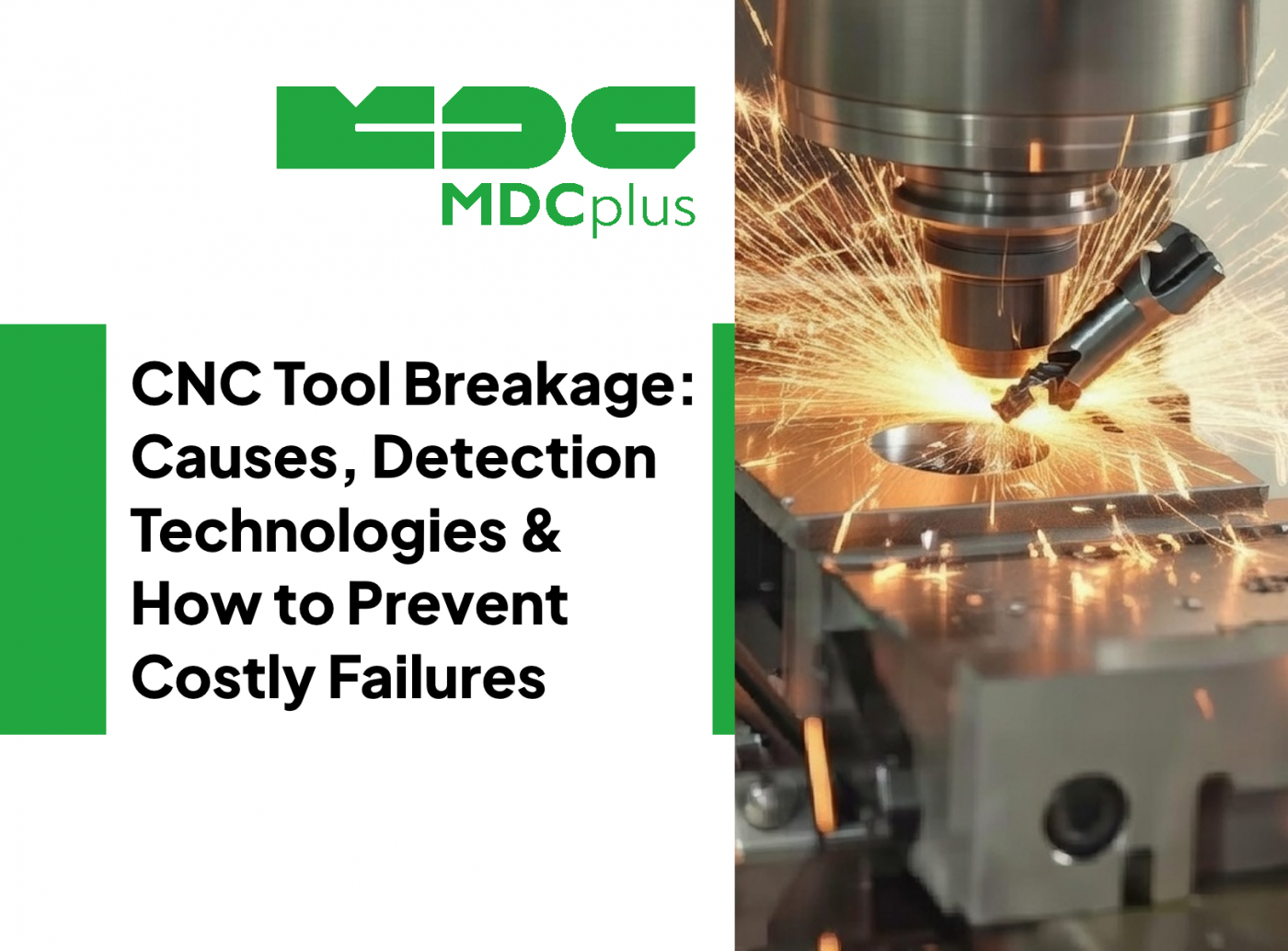
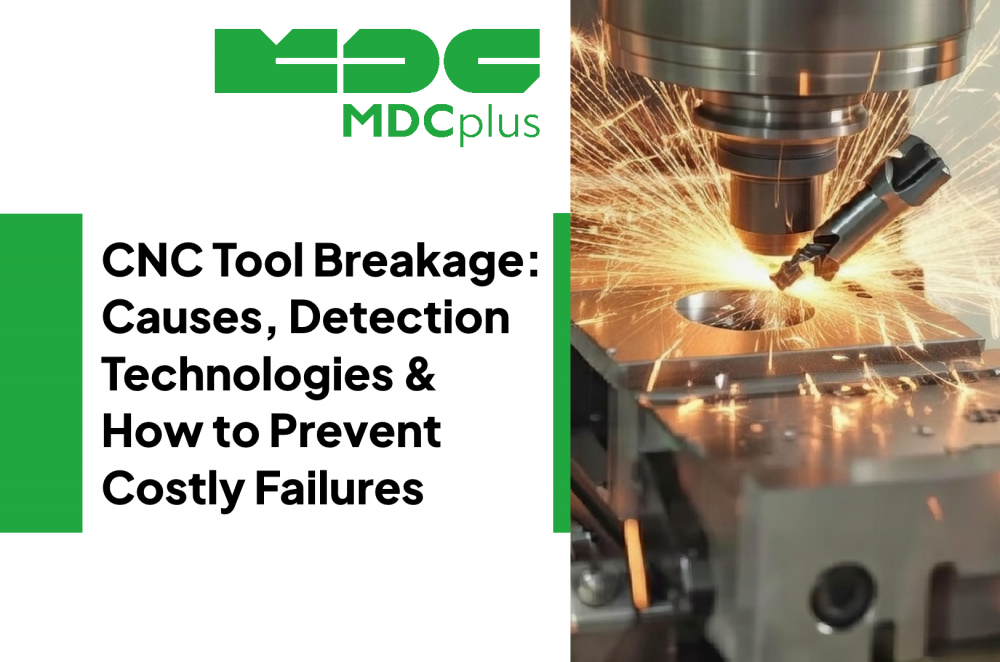
CNC tool breakage is one of the most expensive hidden losses in machining. A broken tool does not only destroy the cutter — it risks scrapping the part, damaging fixtures, and creating unplanned downtime. In high-mix or unattended machining environments, a single undetected break can affect dozens of parts before anyone notices.
What Is CNC Tool Breakage?
CNC tool breakage occurs when a cutting tool fractures, chips, or fails during machining. It may happen suddenly due to overload or gradually due to wear and thermal stress.
Breakage typically falls into three categories:
- Catastrophic fracture (tool snaps instantly)
- Edge chipping or micro-fracture
- Gradual wear leading to dimensional deviation
While wear is expected, undetected breakage leads to scrap and potentially machine damage.
Why CNC Tools Break (Root Causes)
1. Excessive Cutting Load
Too high feed rate, aggressive stepdown, or full-width slotting in hard materials often overloads the tool.
2. Poor Chip Evacuation
Recutting packed chips causes force spikes and thermal overload.
3. Heat Accumulation
Titanium and stainless steel trap heat at the cutting zone, weakening carbide edges.
4. Vibration and Runout
Toolholder runout or long stick-out causes uneven flute loading and premature failure.
5. Incorrect Tool Selection
Using general-purpose tools in difficult materials significantly increases breakage risk.
6. Programming Errors
Vertical plunges, incorrect lead-ins, or aggressive tool engagement transitions can snap tools instantly.
What Is CNC Tool Breakage Detection?
Tool breakage detection refers to technologies that identify when a tool has failed and either stop the machine or trigger an alert before scrap accumulates.
Detection systems fall into four major categories:
- Sensor-based systems
- Sensorless data-driven systems
- Contact probe systems
- Non-contact optical systems
Sensor-Based Detection
These systems use physical sensors mounted inside the machine. They monitor vibration, acoustic emissions, force, or torque.
Advantages:
- High sensitivity
- Immediate physical measurement
Limitations:
- Higher installation cost
- Invasive hardware modifications
- Longer deployment time
Sensorless Monitoring (Control Data Monitoring)
Sensorless systems extract high-frequency data directly from CNC controls — including spindle load, torque, and axis load — to detect abnormal behavior patterns. Instead of measuring the tool directly, these systems analyze machine behavior. Sudden load drops or spikes often indicate breakage.
Advantages:
- No hardware installation
- Fast deployment
- Lower cost
- No warranty impact
When combined with anomaly detection algorithms, sensorless monitoring can identify early warning signals before catastrophic failure.
Contact Breakage Detection
Contact systems use a probe or touch pad. After machining, the tool touches the probe to verify tool length integrity. If the tool is shorter than expected, the system assumes breakage and stops the cycle.
Best suited for:
- High-volume production
- Simple tool geometries
- Automated pallet systems
Non-Contact Detection (Laser and Vision)
Laser systems detect tool length without physical contact. They are ideal for high-speed rotation and thermal deformation detection. Camera-based systems provide high-resolution verification for micro-tools and Swiss machining environments.
Advantages:
- No physical wear on detection device
- High precision for small tools
Limitations:
- Higher capital cost
- Environmental sensitivity (coolant mist, chips)
Real-World Scenario: Swiss CNC Tool Breakage
In Swiss machining, small-diameter tools operate at high RPM with minimal tolerance for vibration. A tool break mid-cycle may not be visible immediately, producing dozens of out-of-spec parts.
Monitoring spindle load patterns in real time can detect abnormal load drops instantly — preventing extended scrap production.
How to Reduce Tool Breakage in Practice
Optimize Cutting Strategy
Use adaptive toolpaths, reduce radial engagement, and avoid full-slot plunges in hard materials.
Match Tool to Material
For titanium: use heat-resistant coatings (AlTiN/TiAlN), lower surface speed, strong coolant flow. For aluminum: use polished flutes to prevent built-up edge. For hardened steel: use reinforced edge prep and proper corner radius.
Improve Rigidity
Minimize tool stick-out. Use precision holders. Reduce runout below 0.01mm for finishing.
Use Real-Time Monitoring
Integrate production monitoring and tool load tracking to identify anomalies immediately.
Common Mistakes That Increase Tool Breakage
- Ignoring spindle load warnings
- Running worn tools past end-of-life
- Using generic tooling in difficult alloys
- Skipping simulation before production
- Not auditing setup repeatability
FAQ: CNC Tool Breakage
Why does my CNC tool keep breaking?
Most frequent causes include incorrect feeds and speeds, excessive stick-out, poor chip evacuation, vibration, or wrong tool selection for the material.
How do you detect tool breakage automatically?
Automatic detection can be achieved through contact probes, laser systems, vibration sensors, or sensorless spindle load monitoring.
Can AI predict tool breakage?
Yes. Machine data analytics and anomaly detection models can identify early failure patterns using high-frequency spindle load and torque data.
Final Takeaway
CNC tool breakage is not just a tooling issue — it is a process stability issue. The most effective strategy combines correct cutting parameters, proper tool selection, stable setups, and real-time monitoring. Manufacturers that treat tool health as measurable production data — rather than reacting after breakage — significantly reduce scrap, improve uptime, and extend tool life.
About MDCplus
Our key features are real-time machine monitoring for swift issue resolution, power consumption tracking to promote sustainability, computerized maintenance management to reduce downtime, and vibration diagnostics for predictive maintenance. MDCplus's solutions are tailored for diverse industries, including aerospace, automotive, precision machining, and heavy industry. By delivering actionable insights and fostering seamless integration, we empower manufacturers to boost Overall Equipment Effectiveness (OEE), reduce operational costs, and achieve sustainable growth along with future planning.
Ready to increase your OEE, get clearer vision of your shop floor, and predict sustainably?
Other articles
17.03.2026
CNC Machine Monitoring: Complete Guide for All Brands (2026)
How to monitor CNC machines in real time - Fanuc, Haas, Mazak, Siemens, DMG Mori and more. Protocols, free setup guides, OEE tracking and MDCPlus integration.
Read more
17.03.2026
Free Manufacturing Software: The Ultimate List (2026)
The complete guide to free and open-source manufacturing software - MES, SCADA, ERP, CAD/CAM, WMS, QMS, IIoT and more. 35+ tools reviewed with honest pros, cons and links.
Read more
16.03.2026
OEE & Production KPIs: The Complete Guide for Manufacturers (2026)
Everything you need to measure and improve OEE, downtime, cycle time, and production KPIs. Formulas, benchmarks, free templates, and real-world examples.
Read more
16.03.2026
CNC Error Codes: Complete Guide for All Brands (2026)
This guide covers alarm code systems for every major CNC brand: Fanuc, Haas, Mazak, Siemens Sinumerik, DMG Mori, Heidenhain, Okuma, Mitsubishi, Mori Seiki, Brother, Makino, and Fagor. For each brand you'll find the most common codes, their causes, and the fastest resolution path.
Read more
16.03.2026
How to Start Monitoring Makino CNC for Free (2026)
Connect Makino Pro 5 and Pro 6 machining centers to real-time monitoring via MTConnect and Focas - free setup guide for horizontal and vertical machining centers.
Read more