Looking for Industry 4.0-ready solution? Try MDCplus
Try it yourself Get guided demo23 January 2026
Industry 4.0 Grant in Vietnam - Decree 80/2021/ND-CP Digitalization Support 2026
This article is the best guide for Decree 80/2021/ND-CP Digitalization Support, explaining funding options in Vietnam, eligibility options and how to make your manufacturing future-proof with this opportunity
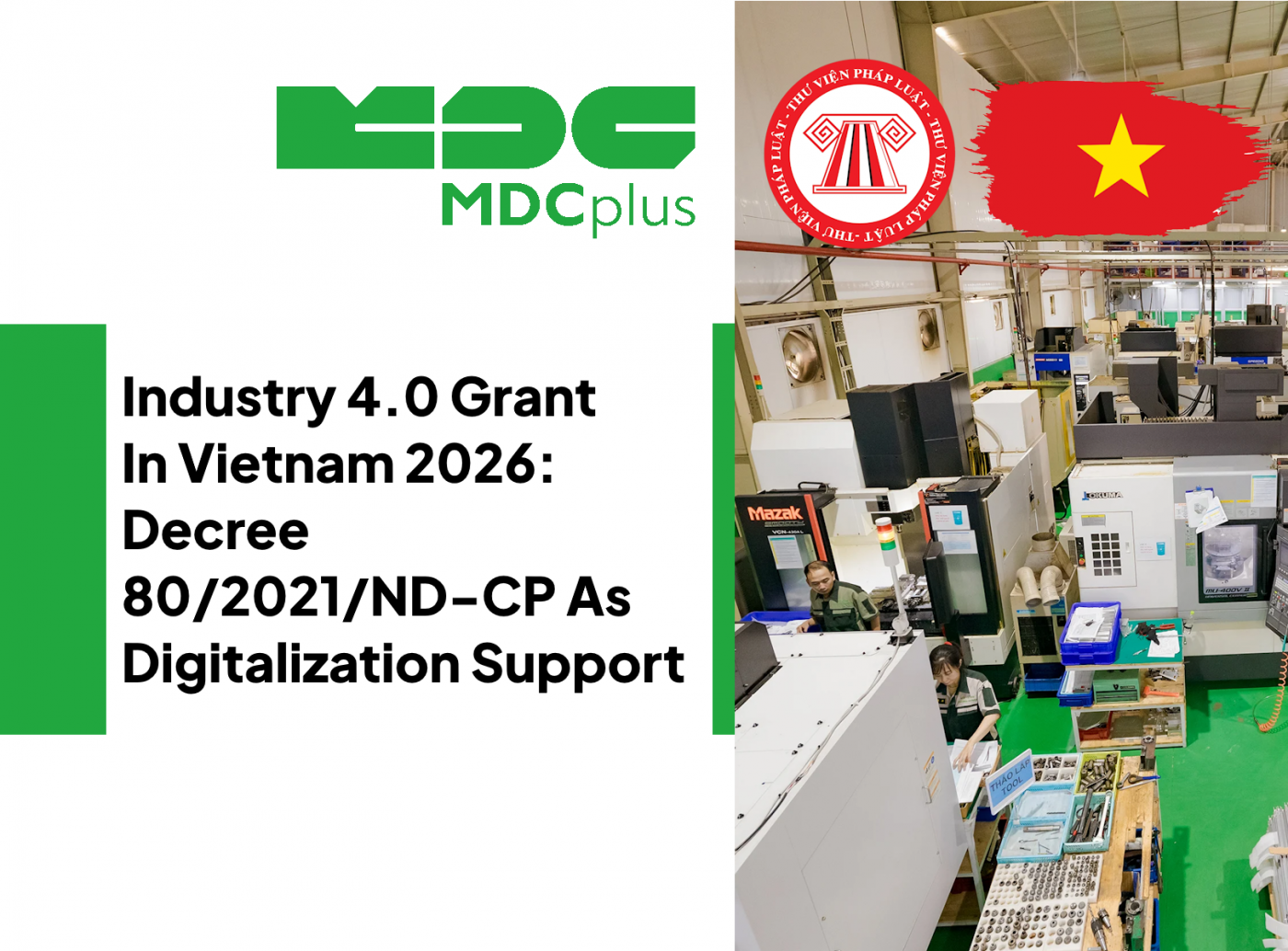
Vietnam’s Decree 80/2021/ND-CP provides a practical path for SMEs to subsidize digitalization activities that support Industry 4.0 outcomes. In practice, companies use this framework to co-fund consulting contracts that cover digital transformation planning and execution support across business processes, management, production, and technology. The exact application steps and benefit ceilings are implemented locally through provincial programs, so the fastest route is to start with your province’s SME support operator and the national SME portal.
Decree 80/2021/ND-CP in 2026 - What This Support Typically Pays For
Decree 80/2021/ND-CP is a national legal framework for supporting SMEs in areas that include technology support, information support, and consultancy. For Industry 4.0, the most relevant mechanism is consulting support that can co-fund advisory contracts connected to digital transformation. This is commonly used to sponsor digitalization of production-related workflows, improve data visibility, and standardize performance management so that later implementation projects become easier to scope and justify.
Instead of working like a single centralized grant program with one national application window, Decree 80 support is operationalized through provincial plans and local implementing agencies. That local layer is where you will find the concrete benefits, eligible scopes, and the submission process you must follow.
Who Can Benefit
This pathway is designed for SMEs operating in Vietnam that meet the SME classification under the national framework. Manufacturing SMEs are a natural fit when the proposed consulting scope is tied to measurable productivity, process control, or modernization outcomes. If your project narrative is “digitalize production visibility, reduce manual reporting, and improve process execution,” it aligns cleanly with the intent of digital transformation consulting support.
Typical Benefits You Can Expect
The most commonly seen benefit model for digital transformation consulting is co-funding up to 50 percent of the consulting contract value, with annual caps that depend on SME size and local rules. Many provincial plans use ceilings in the range of VND 50 million per contract per year for small enterprises and VND 100 million per contract per year for medium enterprises for digital transformation consulting, but you must confirm the exact ceilings in your province because implementation varies.
The support is contract-based. In plain terms, you sign a consulting agreement within the recognized scope, and the province’s SME support operator applies the co-funding rules and documentation requirements tied to that contract.
How This Connects to Industry 4.0 in Manufacturing
For manufacturers, this support is most relevant when your first step is not buying equipment, but building a controlled plan for digitalization and operational visibility. A typical Industry 4.0 use case under this pathway is a consulting engagement that maps production processes, defines what data must be captured, specifies how reporting should work across shifts, and sets the KPIs and governance needed to run a measurable modernization program.
If your objective is direct purchase of machines or full system rollout funding, this is usually not the right instrument. If your objective is to sponsor the work that makes a rollout successful, including diagnostics, requirements, roadmap, and implementation readiness, this can be a strong match.
Where to Apply in Practice
You apply through your local province’s SME support system, not through a single national grant application form. The national SME portal is used to publish information about SME assistance, but practical participation typically runs through provincial People’s Committees and the local agencies they assign to administer SME support.
A practical starting point is the Vietnam National Business Portal operated under the Ministry of Planning and Investment, then narrowing down to your province’s published SME support plan and the responsible department or support center. Many provinces publish their SME support plans publicly, including the specific benefit ceilings and eligible consulting scopes for digital transformation.
Step-by-Step Application Guide
First, confirm that your company qualifies as an SME under the national classification rules and prepare a short profile that matches how provincial operators assess eligibility. In Vietnam, this typically includes your registration information, your business activity domain, and your SME size classification based on the applicable criteria.
Second, identify the provincial SME support plan in your operating location and confirm that it includes consulting support for digital transformation. This is where you validate the co-funding rate, the contract ceilings, the timeline rules, and the required documents. Treat these as the operating rules, because they are the layer that decides your real-world benefit.
Third, define a consulting scope that can be evaluated. The safest scopes are specific and measurable, such as digital transformation assessment for production workflows, a roadmap for data capture and reporting, requirements for production monitoring, and a quantified productivity improvement plan with implementation sequencing.
Fourth, engage a qualified consultant and structure a consulting contract that matches the provincial program’s eligible categories. In some cases, provinces rely on an advisor network or a consultant database governed under the broader Decree 80 framework and related guidance. This is where many applications succeed or fail, because the contract must match what the local operator can legally co-fund.
Fifth, submit your application to the provincial operator, follow the evaluation process, and do not start the engagement in a way that violates the local “approval first” logic if your province requires it. After approval, execute the consulting work and prepare completion evidence and invoices according to the claim requirements used by the province.
What Improves Approval Odds
The strongest applications read like controlled modernization projects rather than vague transformation narratives. You improve your odds by stating a concrete production problem, defining the consulting outputs, and tying those outputs to measurable operational outcomes such as improved uptime reporting integrity, reduced manual reporting time, faster issue escalation, or standardization of shift performance tracking.
You also reduce risk by aligning your contract scope to published provincial categories for digital transformation consulting, rather than trying to fit unrelated software licensing or equipment procurement into an advisory support pathway.
Common Pitfalls
The most common pitfall is assuming that Decree 80 works like a single national grant application. In reality, benefits and procedures are localized. Another frequent issue is writing a consulting scope that is too broad, too abstract, or impossible to verify. When the operator cannot map your contract to an eligible category and a measurable output, the application tends to stall or be rejected.
A third pitfall is mixing categories. If the provincial mechanism is designed to subsidize consultancy, pushing implementation costs, licenses, or unrelated purchases into the same request often creates friction.
Conclusion
In 2026, Decree 80/2021/ND-CP can be used to sponsor digitalization of your production by co-funding eligible consulting contracts that support digital transformation. For Industry 4.0 outcomes, the best-fit use cases are diagnostics, roadmaps, requirements definition, and implementation readiness work that turns modernization into a controlled and measurable program. The decisive step is confirming the specific rules in your province and structuring a contract scope that the local operator can co-fund cleanly.
About MDCplus
Our key features are real-time machine monitoring for swift issue resolution, power consumption tracking to promote sustainability, computerized maintenance management to reduce downtime, and vibration diagnostics for predictive maintenance. MDCplus's solutions are tailored for diverse industries, including aerospace, automotive, precision machining, and heavy industry. By delivering actionable insights and fostering seamless integration, we empower manufacturers to boost Overall Equipment Effectiveness (OEE), reduce operational costs, and achieve sustainable growth along with future planning.
Ready to increase your OEE, get clearer vision of your shop floor, and predict sustainably?
Other articles
17.03.2026
CNC Machine Monitoring: Complete Guide for All Brands (2026)
How to monitor CNC machines in real time - Fanuc, Haas, Mazak, Siemens, DMG Mori and more. Protocols, free setup guides, OEE tracking and MDCPlus integration.
Read more
17.03.2026
Free Manufacturing Software: The Ultimate List (2026)
The complete guide to free and open-source manufacturing software - MES, SCADA, ERP, CAD/CAM, WMS, QMS, IIoT and more. 35+ tools reviewed with honest pros, cons and links.
Read more
16.03.2026
OEE & Production KPIs: The Complete Guide for Manufacturers (2026)
Everything you need to measure and improve OEE, downtime, cycle time, and production KPIs. Formulas, benchmarks, free templates, and real-world examples.
Read more
16.03.2026
CNC Error Codes: Complete Guide for All Brands (2026)
This guide covers alarm code systems for every major CNC brand: Fanuc, Haas, Mazak, Siemens Sinumerik, DMG Mori, Heidenhain, Okuma, Mitsubishi, Mori Seiki, Brother, Makino, and Fagor. For each brand you'll find the most common codes, their causes, and the fastest resolution path.
Read more
16.03.2026
How to Start Monitoring Makino CNC for Free (2026)
Connect Makino Pro 5 and Pro 6 machining centers to real-time monitoring via MTConnect and Focas - free setup guide for horizontal and vertical machining centers.
Read more