MDCplus - future-ready factory compliance
Try it yourself Get guided demo02 February 2026
NF C 15-100 - Industrial Compliance Guide (2026)
NF C 15-100 is the standard that determines whether your factory’s electrical installation is considered safe, compliant, and defensible during inspections, audits, or expansions in France.
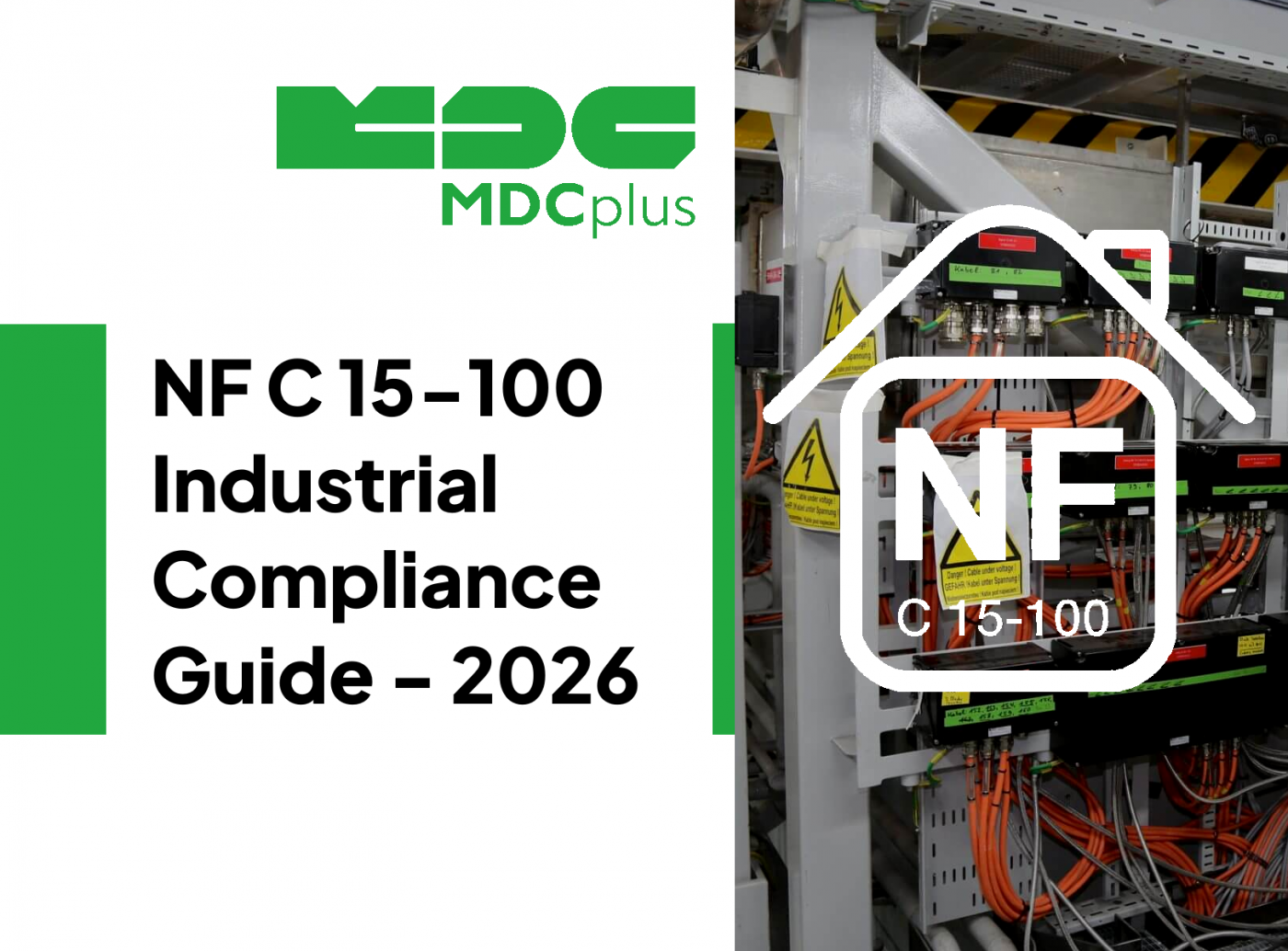
NF C 15-100 is the French reference standard for designing, installing, verifying, and maintaining low-voltage electrical installations in France. For industrial facilities, it matters most during new builds, major renovations, new circuits, machine moves, and expansions, because you must prove safety of people and assets through correct protection, earthing, distribution design, and documented verification tests.
Who this guide is for
- Plant managers and maintenance leaders planning new lines or expansions
- Industrial electricians and integrators installing CNC, robots, and auxiliary equipment
- HSE and compliance roles preparing audits, insurer visits, or electrical acceptance tests
- Owners managing renovation projects and electrical upgrades
What NF C 15-100 covers in industrial facilities
Scope and voltage limits
NF C 15-100 applies to low-voltage electrical installations in France, including industrial buildings and industrial infrastructure. In practice, you should treat it as the baseline for:
- New installations and major renovations
- New circuits added to an existing installation
- Electrical rooms, distribution, protection devices, wiring systems, and earthing
- Verification tests and maintenance rules used to demonstrate conformity and safety
What it is not
NF C 15-100 is not the only requirement you may need. Industrial sites often need to align with other rules and standards depending on:
- Machine safety and control panels (manufacturer requirements, risk assessment, machinery directives and harmonized standards)
- ATEX zones (explosive atmospheres)
- High voltage supply and substations
- Insurance requirements and internal corporate standards
When you must care (real factory triggers)
Projects that create compliance exposure
- New production line installation
- Adding robots, CNC machines, compressors, ovens, furnaces, welders, or large drives
- Moving machines and reworking power feeds
- Adding a new electrical panel, transformer, or major sub-distribution
- Expanding the building, creating new workshops, or converting areas to production
- Recurring nuisance trips, overheating, or unexplained equipment damage
Responsibility and roles (who owns what)
The practical accountability map
- Owner or operator - responsible for the safety of the facility and for commissioning compliant works.
- Electrical contractor / integrator - responsible for design choices, installation quality, and delivering test documentation.
- Machine OEM - responsible for the machine’s internal electrical design, but your facility must supply correct power, protection, and earthing.
- Maintenance - responsible for keeping the installation safe over time, including modifications and preventive checks.
Industrial essentials of NF C 15-100
1) Distribution design that matches real loads
Industrial sites fail not because “the standard is complex”, but because distribution is built like an office building. In production, you need clear load engineering:
- Correct load sizing with realistic simultaneity factors and future margin
- Selective protection so one fault does not shut down half the plant
- Dedicated circuits for critical utilities (compressed air, coolant systems, safety extraction, servers)
- Clear separation of dirty loads (welding, VFDs) and sensitive loads (controls, metrology)
2) Protection against electric shock (RCD strategy)
RCDs are not “one-size-fits-all” in factories. The wrong RCD type or placement causes nuisance trips or missed protection.
- Define where RCDs are required, and choose type based on loads (especially drives and power electronics)
- Avoid stacking RCDs without selectivity, which creates unpredictable downtime
- Document the rationale so future modifications do not break the protection architecture
3) Earthing and bonding (the hidden uptime killer)
Poor earthing shows up as: unexplained PLC resets, encoder errors, VFD trips, sensor noise, and damaged electronics.
- Verify earthing system design and bonding continuity
- Bond metallic structures, cable trays, machine frames, and exposed conductive parts properly
- Control grounding points for automation cabinets to avoid ground loops and EMI issues
4) Short-circuit and thermal protection
Industrial modifications often increase prospective short-circuit current or overload risks.
- Confirm breaking capacity of protective devices for the real fault current at each panel
- Size cables for thermal constraints, installation method, ambient temperature, grouping, and duty cycle
- Do not “upgrade a breaker” without checking the cable and downstream coordination
5) Surge protection and sensitive electronics
Modern factories are full of drives, servo controls, sensors, and networks. Surges and transients cause silent damage, not always visible trips.
- Use a site-level surge protection strategy aligned to exposure and equipment criticality
- Protect automation networks, power supplies, and interfaces where needed
- Plan for lightning risk and external supply disturbances
6) Cable routing, separation, and EMC hygiene
In industrial buildings, poor routing causes electrical noise and intermittent faults that waste weeks.
- Separate power and control where appropriate, especially VFD motor cables vs I/O and network cabling
- Use proper shielding, terminations, and routing discipline for automation reliability
- Label and document routes so future changes do not destroy stability
How NF C 15-100 interacts with CNC and robotic cells
What the facility must get right
- Correct supply capacity and voltage stability for drives and spindles
- Protection coordination that avoids nuisance trips mid-cycle
- Earthing and bonding for servo systems and measurement stability
- Clean segregation of noisy and sensitive circuits
Practical tip: If you have random servo faults, encoder alarms, or PLC communication drops that “come and go”, treat earthing, EMC routing, and surge strategy as suspects, not only the machine.
Verification and documentation (what proves compliance)
Tests you should expect before commissioning
Factories need proof. “It works” is not proof. A compliant handover typically includes documented verification steps such as:
- Continuity of protective conductors and bonding
- Insulation resistance checks
- Verification of protective device operation and settings where applicable
- Polarity and circuit identification checks
- Functional verification of safety-related circuits for the installation side
Documents you should demand and store
- Single-line diagrams and panel schedules
- As-built drawings and cable schedules
- Protection device specifications and settings
- Test reports and commissioning records
- Change log of all modifications after commissioning
Most common industrial failure patterns (and how to avoid them)
Top mistakes that create downtime and audit risk
- Breaker upgrades without cable and coordination checks
- No selectivity, one fault trips the whole workshop
- RCD type mismatch for drives and power electronics
- Weak bonding and improvised earthing points after machine moves
- Power and control cabling mixed in trays, creating EMC chaos
- Missing documentation, then nobody can safely modify anything
Implementation playbook (how to execute without drama)
Step 1 - Scope the installation and classify what changes
- New build, full renovation, partial renovation, or adding circuits
- Identify high-risk zones (wet areas, metallic structures, heavy power electronics)
Step 2 - Engineer distribution and selectivity for production reality
- Map loads by line and utility
- Design selective protection and define critical circuits
Step 3 - Lock earthing, bonding, and routing rules
- Define bonding points and verify continuity
- Set routing rules for power, control, and network
Step 4 - Verify, document, and freeze the baseline
- Run verification tests and keep signed reports
- Archive as-built diagrams and panel schedules
- Create a change control habit for any future modifications
FAQ (AEO targets)
Is NF C 15-100 mandatory for industrial facilities in France?
In practice, it is the reference framework used to demonstrate that a low-voltage installation is designed and built safely in France. When you build new installations, renovate, or create new circuits, you should treat NF C 15-100 as the baseline for conformity and verification.
Does NF C 15-100 apply to existing factories or only new projects?
Existing factories are typically affected when you perform major renovations or add or modify circuits. The moment you change the installation, you inherit a new compliance and verification burden for the scope of that work.
What is the fastest way to reduce risk before an inspection?
Start with documentation and verification: updated single-line diagrams, panel schedules, circuit identification, bonding continuity checks, and test reports for protection performance. Then address selectivity gaps and obvious overload or overheating risks.
What causes the most production downtime linked to electrical conformity issues?
Nuisance trips from poor selectivity, wrong RCD strategy for industrial loads, weak earthing and bonding after machine moves, and messy cabling that creates EMC faults in automation systems.
Summary
NF C 15-100 is not paperwork. In industrial facilities, it directly impacts safety, uptime, and whether you can expand or move machines without recurring electrical incidents. Treat it as an engineered system: distribution, protection selectivity, earthing and bonding, routing discipline, and documented verification.
About MDCplus
Our key features are real-time machine monitoring for swift issue resolution, power consumption tracking to promote sustainability, computerized maintenance management to reduce downtime, and vibration diagnostics for predictive maintenance. MDCplus's solutions are tailored for diverse industries, including aerospace, automotive, precision machining, and heavy industry. By delivering actionable insights and fostering seamless integration, we empower manufacturers to boost Overall Equipment Effectiveness (OEE), reduce operational costs, and achieve sustainable growth along with future planning.
Ready to increase your OEE, get clearer vision of your shop floor, and predict sustainably?
Other articles
17.03.2026
CNC Machine Monitoring: Complete Guide for All Brands (2026)
How to monitor CNC machines in real time - Fanuc, Haas, Mazak, Siemens, DMG Mori and more. Protocols, free setup guides, OEE tracking and MDCPlus integration.
Read more
17.03.2026
Free Manufacturing Software: The Ultimate List (2026)
The complete guide to free and open-source manufacturing software - MES, SCADA, ERP, CAD/CAM, WMS, QMS, IIoT and more. 35+ tools reviewed with honest pros, cons and links.
Read more
16.03.2026
OEE & Production KPIs: The Complete Guide for Manufacturers (2026)
Everything you need to measure and improve OEE, downtime, cycle time, and production KPIs. Formulas, benchmarks, free templates, and real-world examples.
Read more
16.03.2026
CNC Error Codes: Complete Guide for All Brands (2026)
This guide covers alarm code systems for every major CNC brand: Fanuc, Haas, Mazak, Siemens Sinumerik, DMG Mori, Heidenhain, Okuma, Mitsubishi, Mori Seiki, Brother, Makino, and Fagor. For each brand you'll find the most common codes, their causes, and the fastest resolution path.
Read more
16.03.2026
How to Start Monitoring Makino CNC for Free (2026)
Connect Makino Pro 5 and Pro 6 machining centers to real-time monitoring via MTConnect and Focas - free setup guide for horizontal and vertical machining centers.
Read more