Exploring free solutions? Try MDCplus
Try it yourself Get guided demo24 December 2025
Best Free & Open Source Data Visualization Tools For Manufacturers
This list focuses on free and open-source visualization tools that are actively used in industrial and manufacturing environments, especially alongside MES, IIoT, CMMS, ERP, and data lake stacks
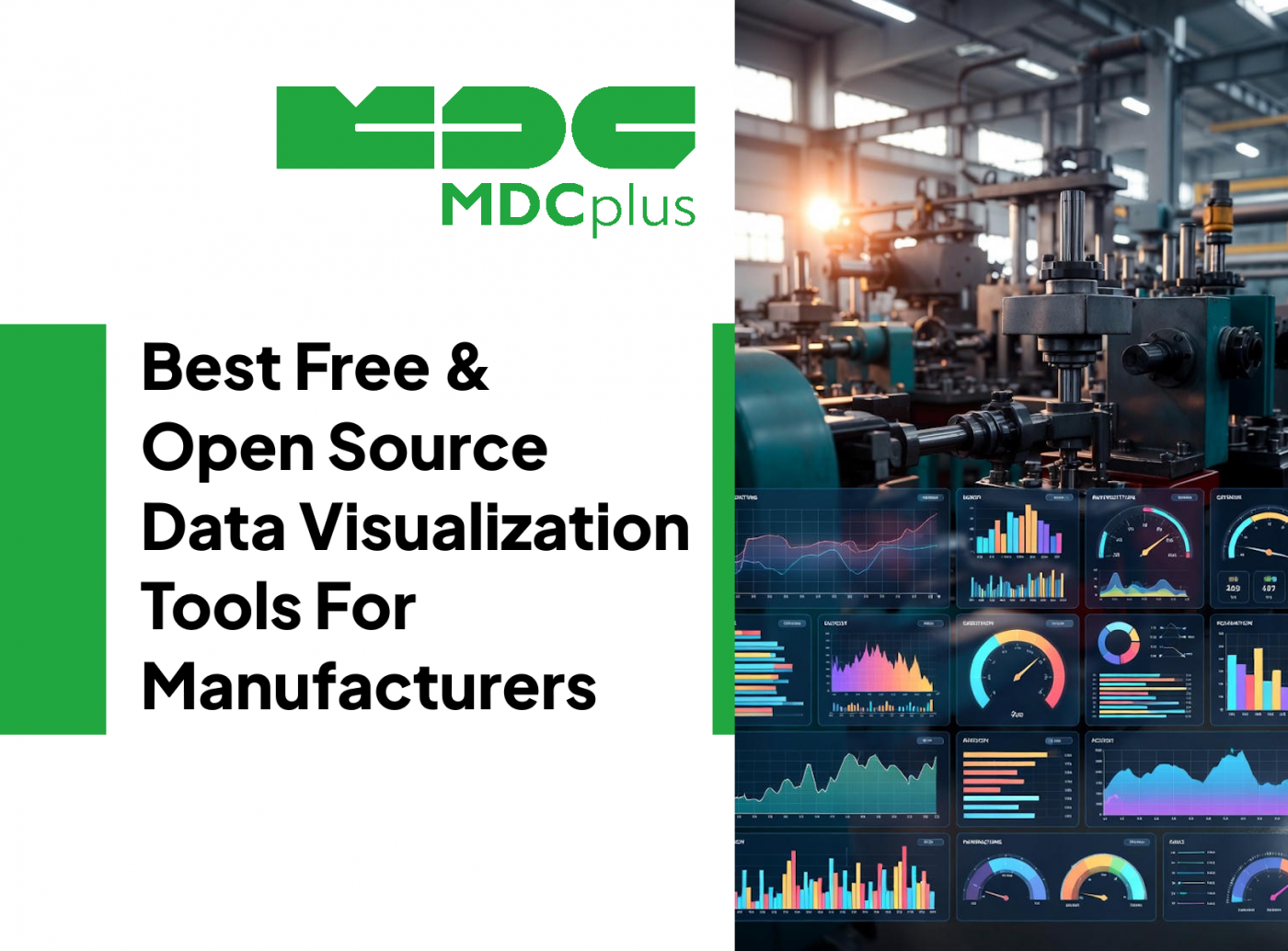
This guide reviews the best free data visualisation tools for manufacturing. For the full overview of free manufacturing software, see the Free Manufacturing Software: The Ultimate List →
Data visualization is not about pretty charts. In manufacturing, it is about making operational data usable by production managers, engineers, and maintenance teams.
Machine states, downtime reasons, OEE, energy consumption, quality metrics, and inventory levels all lose value if they stay in raw tables or logs. Visualization tools turn that data into something people can actually act on.
1. Grafana
Best for: Time-series data, shop-floor dashboards, OEE, energy monitoring
Grafana is the de facto standard for industrial visualization. It connects easily to time-series databases and data lakes and is widely used for machine monitoring, downtime analysis, and energy dashboards.
Visualisation works best on top of a data layer — see free industrial data lake and analytics platforms →
It works well with InfluxDB, Prometheus, TimescaleDB, ClickHouse, and PostgreSQL, which makes it ideal for production environments where data comes from many sources.
Strengths
- Real-time dashboards
- Strong alerting
- Huge ecosystem and community
Limitations
- Limited ad-hoc data exploration
- Not ideal for complex business analytics
License: AGPL / Open Source
2. Apache Superset
Best for: SQL-driven analytics, production and quality analysis
Apache Superset is a modern open-source BI tool designed for analytical queries rather than real-time signals. It excels when you want to explore production history, defect trends, scrap analysis, or performance across shifts and plants.
Superset connects directly to SQL databases and data warehouses, making it suitable for data lakes and MES exports.
Strengths
- Strong SQL analytics
- Flexible charting
- Scales well with large datasets
Limitations
- Less suited for live machine dashboards
- Requires clean data models
License: Apache 2.0
3. Kibana
Best for: Log data, event analysis, operational monitoring
Kibana is tightly coupled with Elasticsearch and is often used in industrial environments to analyze logs, alarms, and event streams from machines, PLCs, and applications.
It is particularly useful for troubleshooting and operational diagnostics rather than KPI reporting.
SCADA dashboards are a form of real-time visualisation — see free SCADA platforms →
Strengths
- Excellent for event and log visualization
- Powerful filtering and search
- Good for root-cause analysis
Limitations
- Requires Elastic stack
- Less intuitive for non-technical users
License: Elastic License (free tier available)
4. Metabase
Best for: Simple dashboards for non-technical users
Metabase focuses on accessibility. It allows engineers and managers to build dashboards and answer questions without writing SQL, while still supporting advanced queries when needed.
It works well for production summaries, inventory overviews, and quality KPIs.
Strengths
- Easy to use
- Fast setup
- Good for mixed technical skill levels
Limitations
- Less powerful for large-scale analytics
- Limited real-time capabilities
License: AGPL / Open Source
5. Redash
Best for: SQL-centric reporting and internal analytics portals
Redash is popular among engineering teams who want simple, query-based dashboards without heavy BI overhead. It integrates well with PostgreSQL, ClickHouse, and data lakes.
Often used to expose production or quality metrics internally.
Strengths
- Clean SQL workflow
- Lightweight
- Good API support
Limitations
- Minimal chart variety
- Less polished UI
License: BSD / Open Source
6. Plotly Dash
Best for: Custom industrial dashboards and engineering tools
Dash is a Python framework for building fully custom dashboards. It is often used when standard BI tools are too restrictive and when visualization needs to be embedded into engineering or operational applications.
Strengths
- Full customization
- Tight integration with Python analytics
- Ideal for digital twins and simulations
Limitations
- Requires development effort
- Not a turnkey BI tool
License: MIT / Open Source
7. Bokeh
Best for: Interactive technical visualizations
Bokeh is a Python visualization library focused on interactive plots. In manufacturing, it is often used for engineering analysis, process modeling, and exploratory data work rather than management dashboards.
Strengths
- Interactive plots
- Python-friendly
- Embeddable in applications
Limitations
- Not a full dashboard platform
- Requires programming skills
License: BSD / Open Source
8. OpenSearch Dashboards
Best for: Open alternative to Kibana
OpenSearch Dashboards is the open-source continuation of Kibana-style visualization after Elastic license changes. It is used for logs, metrics, and event data in operational environments.
Strengths
- Fully open source
- Strong for logs and metrics
- Active community
Limitations
- Less BI-oriented
- Requires OpenSearch backend
License: Apache 2.0
9. Grafana Loki (Visualization via Grafana)
Best for: Machine and system logs correlated with production data
Loki is not a visualization tool by itself, but when paired with Grafana it enables powerful log visualization alongside metrics. This is valuable for correlating machine stops with system events.
Strengths
- Lightweight log storage
- Integrated with Grafana
- Cost-efficient
Limitations
- Requires Grafana
- Focused on logs only
License: AGPL / Open Source
10. Apache Zeppelin
Best for: Exploratory analytics and engineering analysis
Zeppelin provides notebook-style visualization similar to Jupyter, with support for SQL, Python, and Spark. It is useful for advanced production analytics and experimentation.
Strengths
- Flexible analytics
- Good for data science workflows
- Supports big data stacks
Limitations
- Not suited for operational dashboards
- Requires technical users
License: Apache 2.0
Free Data Visualization Tools Comparison
| Tool | Real-Time | SQL Analytics | Best Fit |
|---|---|---|---|
| Grafana | Yes | Limited | Shop-floor dashboards |
| Superset | No | Strong | Production analytics |
| Kibana / OpenSearch | Yes | Medium | Logs & events |
| Metabase | No | Medium | Simple KPIs |
| Redash | No | Strong | Internal analytics |
| Dash / Bokeh | Custom | Custom | Engineering tools |
| Zeppelin | No | Strong | Advanced analysis |
Final Takeaway
In manufacturing, visualization tools fall into three real categories:
- Operational dashboards for live production
- Analytical tools for understanding trends and losses
- Engineering visualization for modeling and diagnostics
Grafana dominates real-time visibility. Superset and Redash handle production analytics. Python-based tools cover advanced use cases.
Related resources:
- Free Manufacturing Software: The Ultimate List
- Free industrial data lake and analytics platforms
- Free ETL and database management for industrial use
- Free industrial AI and ML platforms
About MDCplus
Our key features are real-time machine monitoring for swift issue resolution, power consumption tracking to promote sustainability, computerized maintenance management to reduce downtime, and vibration diagnostics for predictive maintenance. MDCplus's solutions are tailored for diverse industries, including aerospace, automotive, precision machining, and heavy industry. By delivering actionable insights and fostering seamless integration, we empower manufacturers to boost Overall Equipment Effectiveness (OEE), reduce operational costs, and achieve sustainable growth along with future planning.
Ready to increase your OEE, get clearer vision of your shop floor, and predict sustainably?
Other articles
17.03.2026
CNC Machine Monitoring: Complete Guide for All Brands (2026)
How to monitor CNC machines in real time - Fanuc, Haas, Mazak, Siemens, DMG Mori and more. Protocols, free setup guides, OEE tracking and MDCPlus integration.
Read more
17.03.2026
Free Manufacturing Software: The Ultimate List (2026)
The complete guide to free and open-source manufacturing software - MES, SCADA, ERP, CAD/CAM, WMS, QMS, IIoT and more. 35+ tools reviewed with honest pros, cons and links.
Read more
16.03.2026
OEE & Production KPIs: The Complete Guide for Manufacturers (2026)
Everything you need to measure and improve OEE, downtime, cycle time, and production KPIs. Formulas, benchmarks, free templates, and real-world examples.
Read more
16.03.2026
CNC Error Codes: Complete Guide for All Brands (2026)
This guide covers alarm code systems for every major CNC brand: Fanuc, Haas, Mazak, Siemens Sinumerik, DMG Mori, Heidenhain, Okuma, Mitsubishi, Mori Seiki, Brother, Makino, and Fagor. For each brand you'll find the most common codes, their causes, and the fastest resolution path.
Read more
16.03.2026
How to Start Monitoring Makino CNC for Free (2026)
Connect Makino Pro 5 and Pro 6 machining centers to real-time monitoring via MTConnect and Focas - free setup guide for horizontal and vertical machining centers.
Read more