Exploring free solutions? Try MDCplus
Try it yourself Get guided demo17 December 2025
Top 10 Free & Open-Source IoT Infrastructure Platforms for Manufacturing
This article focuses on free and open-source IoT infrastructure platforms that can realistically serve as the backbone of manufacturing IIoT systems
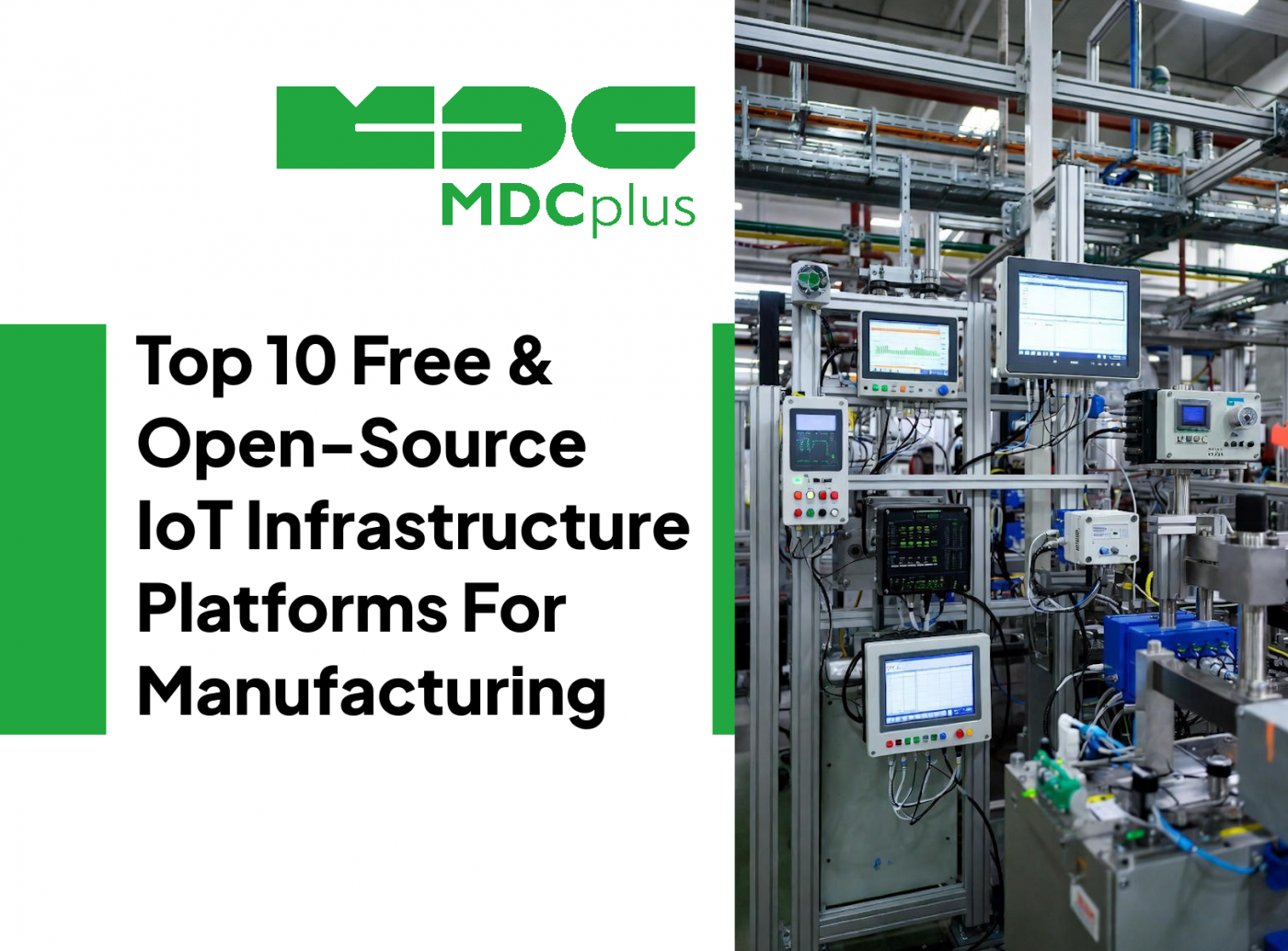
This guide reviews the best free IoT platforms for manufacturing infrastructure. For the full overview of free manufacturing software, see the Free Manufacturing Software: The Ultimate List →
Industrial IoT is no longer about dashboards. At scale, it is about infrastructure: device connectivity, data ingestion, rules, security, storage, and integration with analytics, MES, and CMMS systems.
Many vendors sell “IIoT platforms” as closed black boxes. In practice, the most resilient industrial stacks are built on open-source infrastructure that can run on-prem, scale horizontally, and integrate with OT protocols without locking you into a single ecosystem.
What qualifies as an IoT infrastructure platform here
Included platforms support most of the following:
- Device connectivity (MQTT, HTTP, OPC UA, Modbus via gateways)
- Ingestion of high-volume telemetry
- Rules, processing, or routing of data
- Integration with databases, analytics, and dashboards
- On-prem or self-hosted deployment
Pure visualization tools and hardware-locked systems are excluded.
1. ThingsBoard Community Edition
ThingsBoard CE is one of the most complete open-source IIoT platforms available. It provides device management, MQTT/HTTP/CoAP connectivity, rule chains, alarms, and dashboards in a single stack. In manufacturing, it is often used as:
- a machine telemetry hub
- an alarm and condition monitoring layer
- a lightweight MES-adjacent IIoT platform
License: Apache 2.0, open source.
Best for: End-to-end IIoT platform with dashboards and rules.
Data collected via IoT feeds SCADA layers — see free SCADA platforms →
2. Kaa IoT Platform (Kaa Community Edition)
Kaa is a modular IoT platform focused on device lifecycle management and data ingestion. It supports MQTT, REST, and integrates cleanly with Kafka and analytics stacks. Often used when:
- you need large-scale device fleets
- dashboards are secondary to data pipelines
- analytics happens downstream
License: Apache 2.0, open source.
Best for: Scalable device management and data pipelines.
3. EMQX (Open Source Edition)
EMQX is a high-performance MQTT broker designed for millions of connections. It is widely used in industrial and automotive IIoT systems. Typical roles:
- core MQTT message broker
- gateway between OT devices and IT systems
- ingestion layer for analytics and monitoring
License: Apache 2.0, open source (core).
Best for: Industrial MQTT backbone.
4. Eclipse Mosquitto
Mosquitto is the most widely deployed open-source MQTT broker. It is simple, stable, and perfect for small to mid-scale industrial setups.
Used when:
- you want minimal infrastructure
- devices publish telemetry to a central hub
- other systems handle analytics and storage
License: EPL / EDL, open source.
Best for: Lightweight MQTT deployments.
5. Fledge (LF Edge)
Fledge is an open-source edge platform designed specifically for industrial environments. It supports plugins for OPC UA, Modbus, and custom protocols, buffering data locally before sending it upstream. In factories, Fledge is often:
- installed on edge gateways
- used to normalize OT data
- paired with cloud or on-prem analytics platforms
License: Apache 2.0, open source.
Best for: Industrial edge data collection.
IoT connectivity powers IIoT applications — see free open-source IIoT systems →
6. Node-RED
Node-RED is not a full IoT platform, but it is a critical infrastructure component. It excels at wiring devices, APIs, databases, and rules together. Manufacturing uses:
- decoding PLC or sensor payloads
- transforming and routing data
- triggering alerts or actions
License: Apache 2.0, open source.
Best for: Low-code integration and IoT workflows.
7. ChirpStack
ChirpStack is an open-source LoRaWAN network server. It is widely used for battery-powered sensors measuring vibration, temperature, energy, and environmental conditions. In industrial settings:
- remote assets
- energy monitoring
- hard-to-wire equipment
License: MIT, open source.
Best for: LoRaWAN and low-power industrial IoT.
8. EdgeX Foundry
EdgeX Foundry is a microservices-based edge platform for industrial IoT. It focuses on protocol abstraction, data normalization, and secure northbound integration. It is often chosen for:
- complex OT environments
- multi-vendor device landscapes
- long-term industrial architectures
License: Apache 2.0, open source.
Best for: Vendor-neutral industrial edge architecture.
9. OpenRemote
OpenRemote is an open-source IoT platform focused on asset modeling and rules. It is commonly used in smart infrastructure and industrial monitoring projects. Strengths include:
- asset hierarchies
- rule-based automation
- flexible integrations
License: AGPLv3, open source.
Best for: Asset-centric IoT platforms.
10. Mainflux
Mainflux is a modern open-source IoT platform designed around microservices, APIs, and message brokers. It integrates with MQTT, HTTP, and popular databases. Best suited for:
- cloud-native IIoT backends
- custom industrial applications
- developer-centric teams
License: Apache 2.0, open source.
Best for: Cloud-native, API-driven IoT infrastructure.
Free IoT Platforms Comparison
| Platform | License | Device Connectivity | Edge Support | Rules / Processing | Typical Role |
|---|---|---|---|---|---|
| ThingsBoard CE | Apache 2.0 | Yes | Partial | Yes | Full IIoT platform |
| Kaa CE | Apache 2.0 | Yes | Partial | Limited | Device data backbone |
| EMQX | Apache 2.0 | MQTT | No | Basic | Messaging core |
| Mosquitto | EPL/EDL | MQTT | No | No | Lightweight broker |
| Fledge | Apache 2.0 | Yes (OT focused) | Yes | Plugins | Industrial edge |
| Node-RED | Apache 2.0 | Yes | Yes | Yes | Integration glue |
| ChirpStack | MIT | LoRaWAN | Yes | Limited | Low-power sensors |
| EdgeX Foundry | Apache 2.0 | Yes | Yes | Yes | Edge architecture |
| OpenRemote | AGPLv3 | Yes | Partial | Yes | Asset-centric IIoT |
| Mainflux | Apache 2.0 | Yes | Partial | Yes | Cloud-native backend |
How manufacturers actually combine these tools
A realistic open IIoT stack often looks like:
- Devices & PLCs: OPC UA, Modbus, sensors
- Edge: Fledge + Node-RED
- Messaging: EMQX or Mosquitto
- Platform: ThingsBoard or Kaa
- Storage & analytics: ClickHouse, TimescaleDB, or data lake
- Visualization: Grafana or Superset
This avoids vendor lock-in and keeps control of production data inside your own infrastructure.
Final Thoughts
Industrial IoT infrastructure is no longer about buying a single platform that promises everything. The winning architectures in 2025 are modular, open, and composable.
These open-source platforms give manufacturers the freedom to start small, scale gradually, and integrate deeply with MES, CMMS, analytics, and digital twin systems. The value is not in the logo on the platform, but in owning your data and your architecture.
Related resources:
- Free Manufacturing Software: The Ultimate List
- Free open-source IIoT systems
- Free SCADA software for manufacturing
- Free ETL and database management for industrial use
About MDCplus
Our key features are real-time machine monitoring for swift issue resolution, power consumption tracking to promote sustainability, computerized maintenance management to reduce downtime, and vibration diagnostics for predictive maintenance. MDCplus's solutions are tailored for diverse industries, including aerospace, automotive, precision machining, and heavy industry. By delivering actionable insights and fostering seamless integration, we empower manufacturers to boost Overall Equipment Effectiveness (OEE), reduce operational costs, and achieve sustainable growth along with future planning.
Ready to increase your OEE, get clearer vision of your shop floor, and predict sustainably?
Other articles
17.03.2026
CNC Machine Monitoring: Complete Guide for All Brands (2026)
How to monitor CNC machines in real time - Fanuc, Haas, Mazak, Siemens, DMG Mori and more. Protocols, free setup guides, OEE tracking and MDCPlus integration.
Read more
17.03.2026
Free Manufacturing Software: The Ultimate List (2026)
The complete guide to free and open-source manufacturing software - MES, SCADA, ERP, CAD/CAM, WMS, QMS, IIoT and more. 35+ tools reviewed with honest pros, cons and links.
Read more
16.03.2026
OEE & Production KPIs: The Complete Guide for Manufacturers (2026)
Everything you need to measure and improve OEE, downtime, cycle time, and production KPIs. Formulas, benchmarks, free templates, and real-world examples.
Read more
16.03.2026
CNC Error Codes: Complete Guide for All Brands (2026)
This guide covers alarm code systems for every major CNC brand: Fanuc, Haas, Mazak, Siemens Sinumerik, DMG Mori, Heidenhain, Okuma, Mitsubishi, Mori Seiki, Brother, Makino, and Fagor. For each brand you'll find the most common codes, their causes, and the fastest resolution path.
Read more
16.03.2026
How to Start Monitoring Makino CNC for Free (2026)
Connect Makino Pro 5 and Pro 6 machining centers to real-time monitoring via MTConnect and Focas - free setup guide for horizontal and vertical machining centers.
Read more