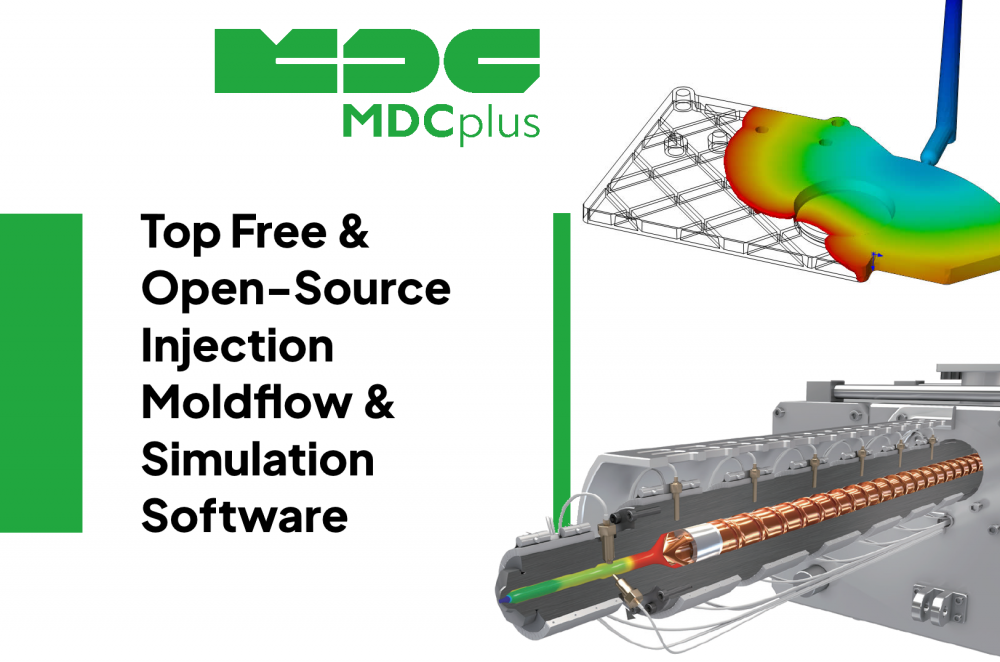
Top Free & Open-Source Injection Moldflow & Simulation Software
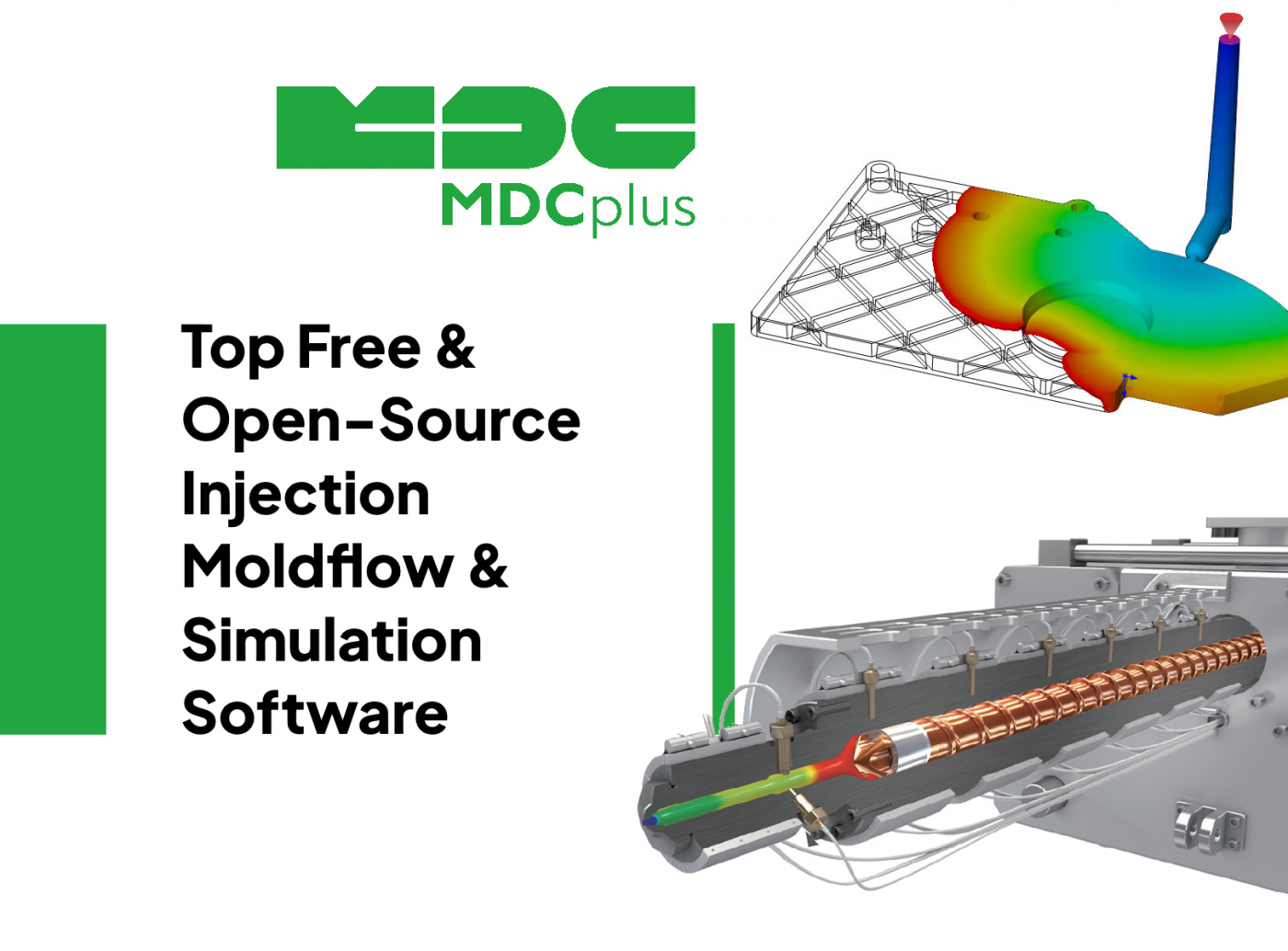
Injection molding simulation used to be locked behind expensive Moldflow or Moldex3D licenses. If you are running a small mold shop or an in house plastics team inside a machine shop, that cost can be hard to justify.
The good news: there is now a serious ecosystem of free and open source tools that can cover big chunks of the moldflow workflow
- melt filling
- packing and cooling
- warpage and structural response
- polymer material modeling
You will not get a single shiny “Autodesk Moldflow clone”, but you can assemble a realistic toolchain that is good enough for design screening, R&D and process support. Included tools match at least one of these:
- Open source, or permanently free edition usable in a small engineering team
- Relevant for injection molding: flow, cooling, warpage or polymer material modeling
- Runs on standard PCs or servers
1. openInjMoldSim - Injection molding solver for OpenFOAM
Best for: Open source filling, packing and cooling simulation.
openInjMoldSim is a dedicated injection molding solver built on OpenFOAM. It models filling, packing and cooling stages with non isothermal, compressible multiphase flow. It was developed as a research grade alternative to commercial codes and validated against Moldex3D and Moldflow in academic work.
You define geometry and mesh in the usual OpenFOAM way, then configure material properties and process conditions for polymer melt. It is not point and click, but if you can live in OpenFOAM dictionaries, you get real moldflow level physics without license cost.
-
Strengths: true injection molding physics, open code, papers backing its accuracy.
-
Limitations: workflow is pure OpenFOAM, no polished GUI, not plug and play for designers.
License: GPL, fully open source.
2. OpenFOAM - General CFD toolbox for polymer filling
Best for: Custom CFD based injection molding workflows and special processes.
OpenFOAM itself is a general CFD toolbox that can solve non Newtonian, multiphase and thermal problems. It has been used in multiple academic works to simulate injection molding filling with custom solvers and material models.
If you have CFD skills, you can
- adapt built in solvers
- couple to user rheology models
- script design of experiments across runner geometries or venting strategies.
- Strengths: maximum flexibility, huge community, zero license cost.
- Limitations: steep learning curve, you must build your own “moldflow workflow”.
License: GPLv3, open source.
3. SimFlow Free - GUI front end for OpenFOAM
Best for: Teams that want OpenFOAM physics with a usable GUI.
SimFlow is a commercial GUI built on top of OpenFOAM. It offers a free version that lets you define geometry, mesh, boundary conditions and run OpenFOAM cases from Windows, macOS or Linux.
It is not injection molding specific, but with non Newtonian and multiphase setups you can configure polymer filling and cooling problems much faster than manual file editing.
- Strengths: removes a big part of the OpenFOAM barrier, good for everyday CFD plus molding cases.
- Limitations: GUI itself is proprietary, free version has limits on mesh size and features.
License: Free tier plus paid plans, uses open source OpenFOAM under the hood.
4. FEATool Multiphysics with OpenFOAM interface
Best for: CAD like pre processing with open solvers underneath.
FEATool Multiphysics is a MATLAB based multiphysics toolbox that can drive open solvers like OpenFOAM and SU2 from a single GUI. It supports CAD style geometry, meshing, physics definition and then hands off the solve to external engines.
For moldflow style simulations you can set up
- non isothermal flow in cavities
- cooling channel flow and heat transfer
- basic structural response of parts.
- Strengths: unified GUI, direct links to OpenFOAM, good for multiphysics problems around molds.
- Limitations: FEATool itself is proprietary, MATLAB environment required, not injection molding specific.
License: Proprietary, but works with open source solvers.
5. Elmer FEM - Warpage, cooling and structural response
Best for: Warpage and thermo mechanical behavior of molded parts and tools.
Elmer is an open source multiphysics FEM package that covers structural mechanics, heat transfer and coupled problems.
If you have pressure and temperature histories from any flow simulation (OpenFOAM, openInjMoldSim, or even a commercial tool), you can feed them into Elmer to study
- residual stresses
- deflection and warpage
- mold base deformation under thermal cycling.
- Strengths: full FEM solver, supports complex materials and coupling, fully open source.
- Limitations: no direct “moldflow wizard” - you must wire the workflow yourself.
License: GPL, open source.
6. CalculiX - FEA for warpage and stress
Best for: Abaqus style structural and thermal FEA without license pain.
CalculiX is a free, open source 3D finite element package compatible with Abaqus input format. It supports linear and nonlinear statics, dynamics and thermal analysis, and is used in manufacturing and electronics for warpage and thermal stress simulations.
For molded parts, you can map residual temperature fields or shrinkage loads and evaluate
- part warpage under cooling
- mold plate distortion
- fatigue in inserts and gates.
- Strengths: heavy duty FEA, familiar input style for Abaqus users, fully free.
- Limitations: pre processing is more old school, no injection specific templates.
License: GPL, open source.
7. Code_Aster - Advanced thermo mechanical analysis
Best for: High end warpage and creep analysis of plastics and tools.
Code_Aster is EDF’s open source FEA solver for structural mechanics and thermodynamics, used for advanced simulation of stresses, strains and thermal fields.
In a moldflow context, it is overkill but very capable for
- complex mold base assemblies
- high temperature gradients
- long term creep or fatigue studies on plastic components.
- Strengths: very powerful, validated in demanding industries, open source.
- Limitations: learning curve and workflow complexity similar to serious commercial FEA.
License: GPL, open source.
8. RadonPy - Polymer property automation for simulation inputs
Best for: Generating polymer material data for simulation and design screening.
RadonPy is an open source toolkit that automates polymer physical property calculations using molecular dynamics simulations. It takes polymer structure, temperature and other settings and computes properties like density, glass transition and mechanical behavior
You still need a CFD or FEM code for moldflow, but RadonPy helps with the upstream problem: reliable material parameters for new or custom polymers when the datasheet is not enough.
- Strengths: first open tool aimed squarely at automated polymer property calculation.
- Limitations: requires MD experience and compute resources, not click and solve.
License: Open source.
9. Polyply + LAMMPS - Polymer structure and MD workflows
Best for: Detailed polymer microstructure effects on processing behavior.
Polyply is an open source Python suite that builds polymer systems for MD simulations and generates input for various force fields.
LAMMPS is a widely used open source MD engine for polymers and soft matter.
Together they give you a pipeline to study
- chain architecture effects
- filler interactions
- temperature dependent properties that feed into rheology and shrinkage models.
- Strengths: extremely flexible, research grade tools for polymer specialists.
- Limitations: not production engineer friendly, best suited for R&D and materials teams.
License: Both open source.
10. ViMag - Visual vibration and structural response of molds and frames
Best for: Checking mold bases, frames and fixtures via video based vibration analysis.
ViMag is an open source visual vibration analysis toolbox that extracts vibration modes from high speed video.
For molding operations it is not about flow, but about the mechanical environment of the machine: base frames, platens, robot mounts. You can identify resonances and mode shapes that later influence part quality and repeatability.
- Strengths: no sensors required, good for quick diagnostics.
- Limitations: indirect method, not a moldflow solver.
License: Open source.
Injection Molding Simulator Comparison
| Tool / Stack | Free | Open source | Focus area | Where it fits in moldflow workflow |
|---|---|---|---|---|
| openInjMoldSim | Yes | Yes | Injection filling, packing, cooling | Core moldflow style solver |
| OpenFOAM | Yes | Yes | General CFD, non Newtonian flow | Custom injection and cooling simulations |
| SimFlow Free | Yes | No (GUI) | OpenFOAM GUI for CFD | Easier OpenFOAM based molding cases |
| FEATool + OpenFOAM | Partial (trial) | Uses OSS solvers | Multiphysics pre post | CAD like setup, runs open solvers |
| Elmer FEM | Yes | Yes | Multiphysics FEM | Warpage, thermo mechanical behavior |
| CalculiX | Yes | Yes | Structural and thermal FEA | Warpage and stress in parts and molds |
| Code_Aster | Yes | Yes | Advanced structural and thermal | High end mold base and part analysis |
| RadonPy | Yes | Yes | Polymer property MD | Input data generation for materials |
| Polyply + LAMMPS | Yes | Yes | Polymer structure and MD | Deep material and rheology studies |
| ViMag | Yes | Yes | Video based vibration | Structural environment and dynamics |
How to build a realistic open stack
If you want something practical for a small molding operation or an in house tooling team:
Flow and cooling
- Use openInjMoldSim or OpenFOAM for filling and packing.
- Optionally drive OpenFOAM through SimFlow or FEATool to reduce friction.
Warpage and stress
- Export temperature and pressure histories into Elmer or CalculiX to compute residual stresses and part warpage.
- Use Code_Aster when you need more advanced load cases or non standard assemblies.
Materials and plant mechanics
- For new polymers, run RadonPy or Polyply + LAMMPS to build a better material model than “copy some similar grade from a datasheet”.
- Use ViMag occasionally to verify that frames, bases and fixtures are not resonating in ways that ruin your nice simulation assumptions.
You will not beat a polished Moldflow workstation in convenience, but you will get a serious, transparent moldflow environment without paying per seat. The tradeoff is clear: more engineering effort, more control, zero license lock in.
About MDCplus
Our key features are real-time machine monitoring for swift issue resolution, power consumption tracking to promote sustainability, computerized maintenance management to reduce downtime, and vibration diagnostics for predictive maintenance. MDCplus's solutions are tailored for diverse industries, including aerospace, automotive, precision machining, and heavy industry. By delivering actionable insights and fostering seamless integration, we empower manufacturers to boost Overall Equipment Effectiveness (OEE), reduce operational costs, and achieve sustainable growth along with future planning.
Ready to increase your OEE, get clearer vision of your shop floor, and predict sustainably?