Exploring free solutions? Try MDCplus
Try it yourself Get guided demo05 January 2026
Best Free & Open Source Packaging Design and Simulation Tools For Manufacturers
This article covers free and open-source tools that are realistically used by manufacturers, packaging engineers, and operations teams. No branding or label-only tools. No consumer design apps.
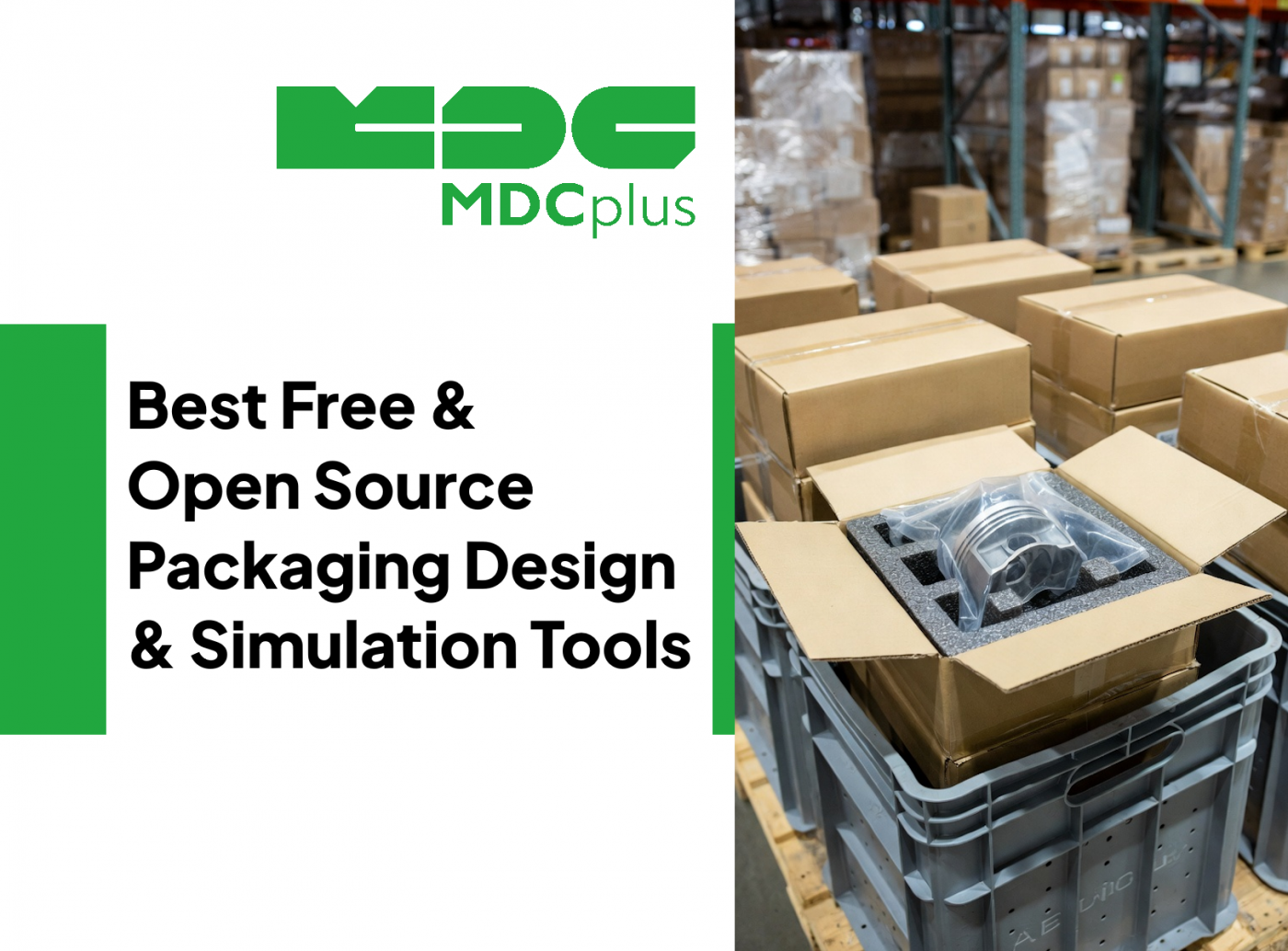
Packaging in manufacturing is not just about appearance. It is about fit, protection, cost, material efficiency, and survivability in real logistics conditions.
For manufacturers, packaging design software is used to:
- design boxes, inserts, trays, and protective structures
- validate fit against real products
- simulate loads, stacking, and transport stress
- reduce material usage and shipping damage
What qualifies as packaging design & simulation software
Included tools support at least one of the following:
- structural packaging design (boxes, inserts, fixtures)
- parametric sizing and fit
- material behavior or load analysis
- logistics-related simulation (stacking, compression, vibration)
Pure graphic design tools are excluded.
1. FreeCAD
Best for: Structural packaging design and parametric control
FreeCAD is one of the most practical open-source tools for packaging engineers. It allows parametric modeling of boxes, trays, inserts, and custom protective structures.
Common manufacturing uses include:
- fitting packaging to real product geometry
- adjusting dimensions for tolerance and variation
- designing reusable packaging and fixtures
With the FEM workbench, FreeCAD can also be used for basic structural analysis.
License: LGPL / Open Source
2. LibreCAD
Best for: 2D packaging layouts and dielines
LibreCAD is widely used for 2D packaging layouts, especially for:
- box dielines
- fold patterns
- flat layouts for cutting or die making
It is often used when packaging is produced by external suppliers who require clean 2D drawings.
License: GPL / Open Source
3. Inkscape
Best for: Packaging layouts and print-ready dielines
Inkscape is not an engineering tool, but it is frequently used for:
- dieline refinement
- multi-layer packaging layouts
- export to print and cutting systems
Manufacturers often pair Inkscape with CAD tools to finalize layouts.
License: GPL / Open Source
4. OpenFOAM
Best for: Advanced simulation of airflow and transport conditions
OpenFOAM is used in advanced packaging scenarios where airflow, cooling, or pressure matters. Examples include:
- ventilated packaging
- temperature-sensitive goods
- airflow through stacked containers
Trade-off:
Powerful but complex. Best for engineering teams.
License: GPL / Open Source
5. CalculiX
Best for: Structural simulation of packaging loads
CalculiX is commonly used to simulate:
- compression and stacking loads
- deformation of packaging under weight
- material stress in inserts or supports
It is especially useful for validating whether packaging survives transport and storage.
License: GPL / Open Source
6. Elmer FEM
Best for: Multi-physics packaging simulations
Elmer FEM supports structural, thermal, and multi-physics simulations. In packaging, it is used for:
- temperature effects on materials
- combined mechanical and thermal stress
- cold-chain packaging analysis
License: GPL / Open Source
7. KiCad (for packaging fixtures)
Best for: Packaging fixtures for electronics
While KiCad is an electronics design tool, it is often used to design:
- PCB trays
- ESD packaging
- electronic transport fixtures
Its mechanical exports integrate well with CAD tools.
License: GPL / Open Source
8. Salome
Best for: Pre-processing and simulation workflows
Salome is used as a pre-processing platform for meshing and simulation when working with:
- structural analysis
- CFD
- complex packaging geometries
It is commonly paired with CalculiX or OpenFOAM.
License: LGPL / Open Source
9. Blender (engineering visualization)
Best for: Visual validation and presentation
Blender is not a simulation tool, but manufacturers use it to:
- visualize packaging assemblies
- validate fit and handling
- create internal documentation and training visuals
License: GPL / Open Source
10. Parametric Packaging Scripts (Python-based)
Best for: High-volume, standardized packaging
Many manufacturers use Python scripts combined with CAD tools to generate:
- parametric box sizes
- insert patterns
- reusable packaging families
This approach is common when packaging must scale across many product variants.
License: Open / Custom
How manufacturers actually use these tools
Most manufacturers do not rely on a single packaging tool. A realistic workflow looks like this:
- CAD tool for structural design
- 2D tool for dielines and cutting layouts
- FEM or CFD tool for validation
- visualization tool for communication
Here is the comparison table of the solution
| Tool | Packaging Types Supported |
|---|---|
| FreeCAD | Structural packaging, boxes, trays, inserts, reusable packaging, custom fixtures |
| LibreCAD | 2D dielines, fold patterns, flat packaging layouts |
| Inkscape | Print-ready dielines, cutting layouts, multi-layer packaging drawings |
| OpenFOAM | Ventilated packaging, airflow-sensitive packaging, thermal transport scenarios |
| CalculiX | Load-bearing packaging, stacking simulation, compression-resistant packaging |
| Elmer FEM | Thermal packaging, cold-chain packaging, combined thermal-mechanical stress |
| KiCad | PCB trays, ESD packaging, electronics transport fixtures |
| Salome | Complex packaging geometries for simulation, multi-part packaging assemblies |
| Blender | Visual validation of packaging assemblies, handling and fit visualization |
| Parametric Python Packaging Scripts | Standardized box families, scalable inserts, high-volume repeatable packaging |
Simulation is used selectively, not everywhere. It is applied when damage costs exceed modeling effort.
Final Takeaway
Free and open-source tools are fully capable of supporting industrial packaging design and simulation. They can model geometry, validate structural behavior, and support logistics-driven decisions. The limitation is not software capability. It is whether packaging is treated as an engineering problem or as an afterthought. Manufacturers who invest in structural packaging design reduce damage, material usage, and logistics cost without increasing product complexity.
About MDCplus
Our key features are real-time machine monitoring for swift issue resolution, power consumption tracking to promote sustainability, computerized maintenance management to reduce downtime, and vibration diagnostics for predictive maintenance. MDCplus's solutions are tailored for diverse industries, including aerospace, automotive, precision machining, and heavy industry. By delivering actionable insights and fostering seamless integration, we empower manufacturers to boost Overall Equipment Effectiveness (OEE), reduce operational costs, and achieve sustainable growth along with future planning.
Ready to increase your OEE, get clearer vision of your shop floor, and predict sustainably?
Other articles
17.03.2026
CNC Machine Monitoring: Complete Guide for All Brands (2026)
How to monitor CNC machines in real time - Fanuc, Haas, Mazak, Siemens, DMG Mori and more. Protocols, free setup guides, OEE tracking and MDCPlus integration.
Read more
17.03.2026
Free Manufacturing Software: The Ultimate List (2026)
The complete guide to free and open-source manufacturing software - MES, SCADA, ERP, CAD/CAM, WMS, QMS, IIoT and more. 35+ tools reviewed with honest pros, cons and links.
Read more
16.03.2026
OEE & Production KPIs: The Complete Guide for Manufacturers (2026)
Everything you need to measure and improve OEE, downtime, cycle time, and production KPIs. Formulas, benchmarks, free templates, and real-world examples.
Read more
16.03.2026
CNC Error Codes: Complete Guide for All Brands (2026)
This guide covers alarm code systems for every major CNC brand: Fanuc, Haas, Mazak, Siemens Sinumerik, DMG Mori, Heidenhain, Okuma, Mitsubishi, Mori Seiki, Brother, Makino, and Fagor. For each brand you'll find the most common codes, their causes, and the fastest resolution path.
Read more
16.03.2026
How to Start Monitoring Makino CNC for Free (2026)
Connect Makino Pro 5 and Pro 6 machining centers to real-time monitoring via MTConnect and Focas - free setup guide for horizontal and vertical machining centers.
Read more