Exploring free solutions? Try MDCplus
Try it yourself Get guided demo09 December 2025
What Is Laser Milling Technology and How Is It Used
This guide explains laser milling in simple terms, covers real industrial applications, lists top machine models and outlines the future of this technology
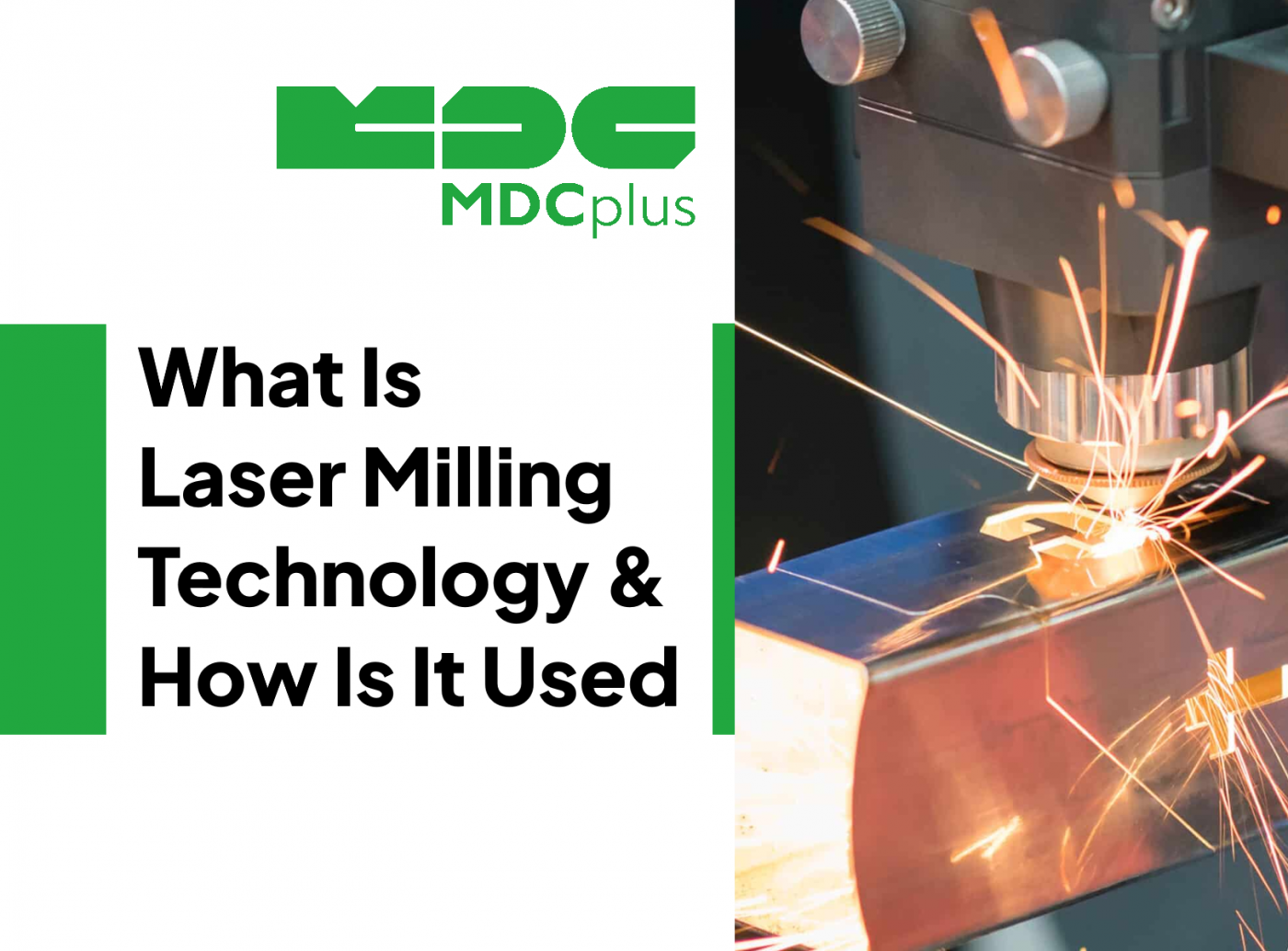
Laser milling is one of the fastest growing precision manufacturing technologies. It allows shops to create micro features, textures and complex geometries that are difficult or impossible to produce with traditional CNC cutting.
What Is Laser Milling?
Laser milling is a hybrid subtractive process that removes material with a focused laser beam instead of a physical cutting tool. The machine uses CNC motion control to guide the laser while material is ablated layer by layer. The result is extreme precision with no mechanical contact.
The core principles are straightforward:
- A high energy laser beam hits the surface of the material.
- Material is vaporized or melted and ejected in controlled micro layers.
- CNC axes position the beam with micron level accuracy.
- The process repeats until the final shape or texture is achieved.
Laser milling differs from traditional CNC milling because it relies on thermal removal instead of mechanical forces. There is no cutter deflection, no tool wear, no chatter and no need for cutting fluids.
Common laser sources include fiber lasers, picosecond lasers and femtosecond lasers. Shorter pulse durations generate cleaner edges and reduce thermal damage.
What Is Laser Milling Used For?
Laser milling serves industries that need very high precision or work with materials that are difficult to machine. Typical applications include:
- Aerospace cooling channels, turbine blade features and flow control structures
- Medical implant texturing, stent slots and surgical tool details
- Microelectronics heat sinks, micro cavities and semiconductor components
- Mold and die texturing for plastics, rubber, injection molds and high end consumer goods
Why manufacturers choose laser milling:
- No tool wear
- High repeatability and stable quality
- Excellent surface finish
- Ability to process hard metals, ceramics, carbides and brittle materials
- Ideal for micro features, thin walls and delicate geometries
Limitations include slower material removal rates and higher initial investment. However, in precision manufacturing the process advantages often outweigh these drawbacks.
Who Uses Laser Milling Today?
Laser milling is already part of daily production in aerospace, medical, electronics and mold making. Instead of machine OEMs, these are the types of companies actively running laser milling cells:
1. Precision Micromachining Shops
Specialized laser service providers supply high precision parts to major OEMs.
- Optek Systems produces laser milled features for aerospace, medical and semiconductor parts.
- Gateway Laser Services runs production scale micromachining for medical and aerospace components.
- Micron Laser Technology delivers micro holes, slots and pockets for defense, medical and high tech electronics.
These shops operate laser milling as a core capability, not just prototyping.
2. Medical Device Manufacturers
Laser milling is used for microfluidic channels, implant texturing and tiny precision features that are impossible with mechanical tools. Many device makers rely on suppliers like AMS Micromedical and Lighteum for this work.
3. Aerospace Tier Suppliers
Laser milling enables cavities, cooling features and micro structures in turbine components and high strength alloys. Most engine OEMs outsource this to specialist laser machining houses under long term supply contracts.
4. Mold and Die Texturing Companies
Automotive and consumer product mold makers increasingly rely on laser milling for 5 axis texturing and engraving. Companies like Custom Etch and Standex Mold Tech use laser milling to replace chemical etching for complex textures.
5. Semiconductor and Electronics Producers
Laser milling supports micro cavities in ceramics and silicon, PCB precision features and advanced packaging. High tech OEMs and outsourced laser specialists handle much of this production at volume.
Which Machines Are Best for Laser Milling?
Selecting the right system depends on the part type, precision needed and material. Key selection criteria:
- Laser characteristics such as wavelength, pulse duration and power
- Axis configuration, usually 3 axis or 5 axis
- Positioning accuracy, repeatability and thermal stability
- CAM and machine software integration
- Whether a hybrid additive or dedicated laser milling platform is required
Notable machines in 2024 to 2025 include:
- DMG MORI LASERTEC 400 Shape for large molds and complex surface textures
- GF LASER P 600U for micro texturing, fine engraving and surface engineering
- Sodick OPM350L for combined metal 3D printing and laser milling in mold production
- Trumpf TruLaser Cell 7040 for flexible multi process laser machining
- GF Microlution ML 10 for femtosecond precision in electronics and medical components
These systems represent the current benchmark for industrial laser milling performance.
What Is the Future of Laser Milling?
Laser milling is becoming a central part of next generation precision manufacturing. Several trends are shaping its growth:
-
Hybrid manufacturing
More systems now combine additive and laser milling for complete part production in one machine. -
AI driven process optimization
Real time monitoring, adaptive path control and digital twins will improve accuracy and reduce cycle times. -
Cold ablation with ultrashort pulse lasers
Femtosecond and picosecond lasers allow near zero heat affected zones, enabling tighter tolerances and cleaner edges. -
Rising demand for micro components
Medical devices, microfluidics, semiconductors and battery technologies require features that only laser milling can produce. -
Sustainability and clean manufacturing
Laser milling uses no cutting fluids, produces minimal waste and supports energy efficient production.
The technology will continue to expand as manufacturers push for tighter accuracy, less tool wear and more digital automation.
Final Summary
Laser milling is a powerful non contact precision machining method that uses focused laser energy to remove material with unmatched accuracy. It is ideal for hard materials, micro features and advanced surface textures. Adoption is growing across aerospace, medical, electronics and mold making. As AI, hybrid systems and ultrashort pulse lasers mature, laser milling will become a cornerstone of high precision manufacturing.
About MDCplus
Our key features are real-time machine monitoring for swift issue resolution, power consumption tracking to promote sustainability, computerized maintenance management to reduce downtime, and vibration diagnostics for predictive maintenance. MDCplus's solutions are tailored for diverse industries, including aerospace, automotive, precision machining, and heavy industry. By delivering actionable insights and fostering seamless integration, we empower manufacturers to boost Overall Equipment Effectiveness (OEE), reduce operational costs, and achieve sustainable growth along with future planning.
Ready to increase your OEE, get clearer vision of your shop floor, and predict sustainably?
Other articles
17.03.2026
CNC Machine Monitoring: Complete Guide for All Brands (2026)
How to monitor CNC machines in real time - Fanuc, Haas, Mazak, Siemens, DMG Mori and more. Protocols, free setup guides, OEE tracking and MDCPlus integration.
Read more
17.03.2026
Free Manufacturing Software: The Ultimate List (2026)
The complete guide to free and open-source manufacturing software - MES, SCADA, ERP, CAD/CAM, WMS, QMS, IIoT and more. 35+ tools reviewed with honest pros, cons and links.
Read more
16.03.2026
OEE & Production KPIs: The Complete Guide for Manufacturers (2026)
Everything you need to measure and improve OEE, downtime, cycle time, and production KPIs. Formulas, benchmarks, free templates, and real-world examples.
Read more
16.03.2026
CNC Error Codes: Complete Guide for All Brands (2026)
This guide covers alarm code systems for every major CNC brand: Fanuc, Haas, Mazak, Siemens Sinumerik, DMG Mori, Heidenhain, Okuma, Mitsubishi, Mori Seiki, Brother, Makino, and Fagor. For each brand you'll find the most common codes, their causes, and the fastest resolution path.
Read more
16.03.2026
How to Start Monitoring Makino CNC for Free (2026)
Connect Makino Pro 5 and Pro 6 machining centers to real-time monitoring via MTConnect and Focas - free setup guide for horizontal and vertical machining centers.
Read more