Want to take on more jobs? MDCplus can help
Try it yourself Get guided demo19 December 2025
Where To Find Parts Orders: Manufacturing Marketplaces and Xometry Alternatives
Below is a practical overview of platforms manufacturers actually use today, with a focus on industrial, engineering-driven, and regional sourcing channels
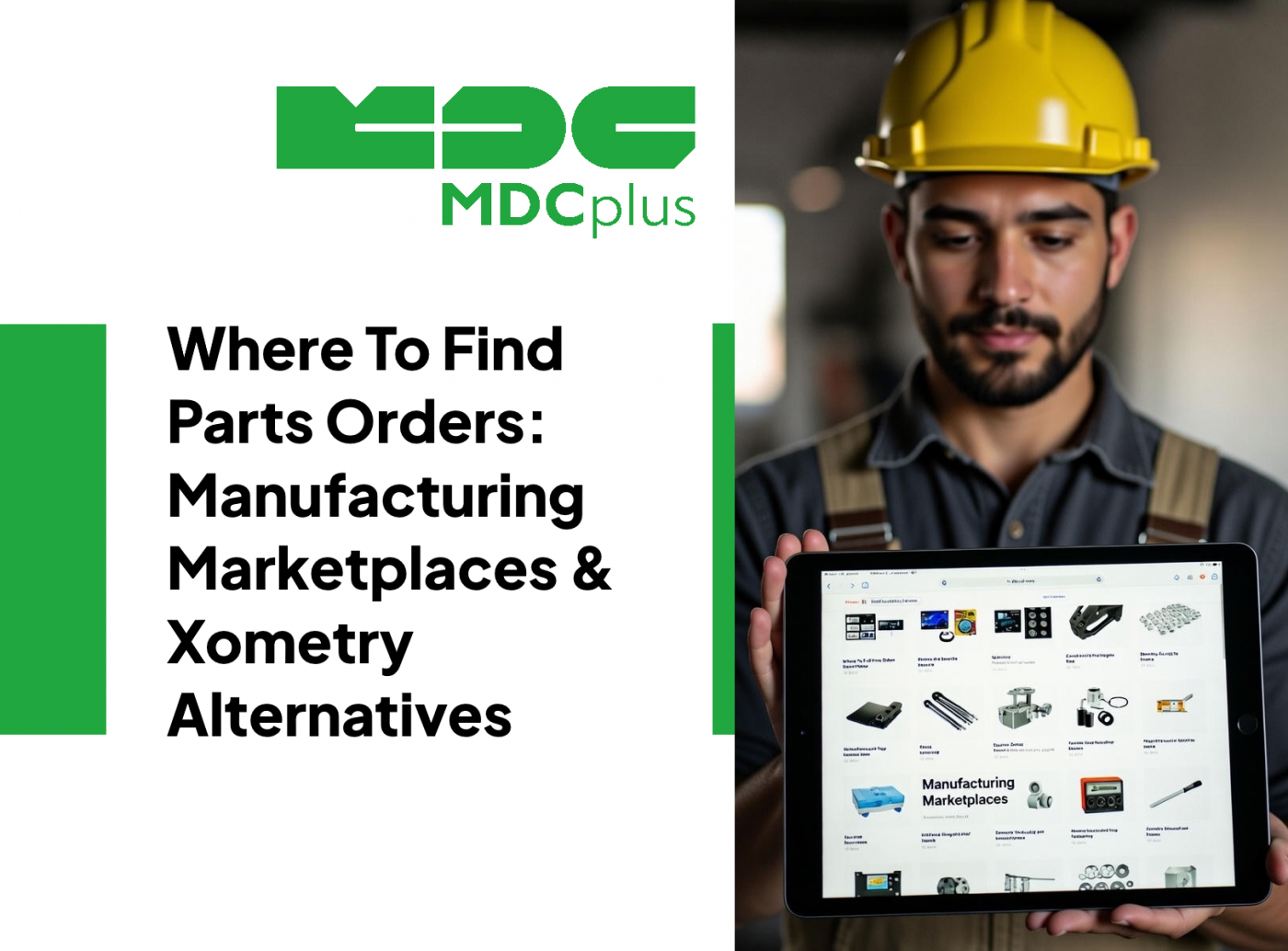
Digital manufacturing marketplaces have become a real sales channel for machine shops, fabricators, and contract manufacturers. For many shops, they act as an external demand engine when direct sales pipelines are inconsistent or still forming. The key difference between platforms in 2026 is not volume, but signal quality. Broad B2B marketplaces generate noise. Niche industrial platforms generate fewer leads, but those leads convert into real production contracts.
Xometry
Xometry remains the reference point for instant-quote manufacturing, particularly in the US. It excels at fast order flow and automated pricing, which makes it useful for filling idle machine time.
Its advantage is predictable volume with minimal sales effort. Its limitation is margin pressure and lack of customer ownership. Xometry works best as a utilization tool, not as the foundation of a shop’s sales strategy.
Hubs / 3D Hubs
Hubs sits closer to engineering teams and product developers. Orders tend to be better defined, with fewer last-minute changes and clearer drawings.
For European manufacturers, Hubs often delivers higher-quality demand than pure price-driven platforms. The tradeoff is lower volume and limited negotiation flexibility. Like most managed networks, customer relationships remain platform-owned.
Protolabs Network
Protolabs operates a curated manufacturing network rather than an open marketplace. Work is structured, expectations are clear, and quality requirements are high.
The benefit is operational predictability. The downside is selectivity. Not every shop qualifies, and the scope of work is narrower than on open platforms. Protolabs is a good fit for mature, process-driven manufacturers.
Fictiv
Fictiv attracts customers who value engineering collaboration and manufacturability feedback. Orders are typically lower volume but higher complexity.
This platform favors shops with strong communication, documentation, and quality discipline. Job volume is lower than commodity marketplaces, but margins and repeat business potential are usually better.
Zetwerk
Zetwerk connects manufacturers to large industrial buyers sourcing at scale. It is commonly used for machining, fabrication, castings, and assemblies across global supply chains.
The upside is access to repeat, high-volume work. The downside is operational overhead and structured vendor management. Zetwerk works best for shops comfortable operating as part of a larger industrial ecosystem.
MFG.com
MFG.com follows a classic RFQ-driven sourcing model. Buyers post requirements, suppliers respond, and direct communication follows.
The main advantage is customer ownership and negotiation flexibility. The cost is effort. Quoting is manual, and lead quality varies. This platform suits manufacturers who prefer relationship-based sales over instant pricing.
Thomasnet
Thomasnet functions as an industrial discovery and sourcing platform rather than a transactional marketplace. Buyers are typically OEMs, engineers, and procurement teams looking for long-term suppliers.
The strength here is trust and intent. Leads are fewer but more serious. Sales cycles are longer, and success depends on profile quality, certifications, and follow-up discipline.
GlobalSpec
GlobalSpec is heavily used by engineers searching for suppliers, components, and manufacturing capabilities. RFQs often originate from design and engineering teams rather than procurement.
This makes GlobalSpec particularly valuable for specialized shops offering tight tolerances, specific materials, or niche processes. Volume is lower, but technical fit and margins are often better.
MakeTime
MakeTime still generates occasional CNC machining work, mainly from legacy users. However, activity has declined, and pricing dynamics mirror Xometry.
Most manufacturers treat MakeTime as a secondary channel rather than a growth platform.
Local and Regional Industrial Platforms
Europe, United States, and India
Regional platforms consistently outperform global mass marketplaces when it comes to quality of demand.
Europe
Platforms such as Wer liefert was, Europages, and IndustryStock connect manufacturers directly with regional OEMs and Tier suppliers. These leads convert more slowly but result in longer-term relationships and better margins.
United States
In addition to Thomasnet and GlobalSpec, platforms like Kompass US are used by buyers sourcing domestically. These channels reward specialization and clear positioning rather than price competition.
India
Platforms such as MSME Mart and sector-specific supplier portals are often more effective than generic B2B sites. They focus on industrial sourcing and government-linked demand, with less noise than mass marketplaces.
Manufacturers who succeed with marketplaces treat them as segmented demand channels, not as a single funnel. The strongest shops use several channels, measure margins per channel, and gradually shift from anonymous marketplace work toward direct, repeat customers.
About MDCplus
Our key features are real-time machine monitoring for swift issue resolution, power consumption tracking to promote sustainability, computerized maintenance management to reduce downtime, and vibration diagnostics for predictive maintenance. MDCplus's solutions are tailored for diverse industries, including aerospace, automotive, precision machining, and heavy industry. By delivering actionable insights and fostering seamless integration, we empower manufacturers to boost Overall Equipment Effectiveness (OEE), reduce operational costs, and achieve sustainable growth along with future planning.
Ready to increase your OEE, get clearer vision of your shop floor, and predict sustainably?
Other articles
17.03.2026
CNC Machine Monitoring: Complete Guide for All Brands (2026)
How to monitor CNC machines in real time - Fanuc, Haas, Mazak, Siemens, DMG Mori and more. Protocols, free setup guides, OEE tracking and MDCPlus integration.
Read more
17.03.2026
Free Manufacturing Software: The Ultimate List (2026)
The complete guide to free and open-source manufacturing software - MES, SCADA, ERP, CAD/CAM, WMS, QMS, IIoT and more. 35+ tools reviewed with honest pros, cons and links.
Read more
16.03.2026
OEE & Production KPIs: The Complete Guide for Manufacturers (2026)
Everything you need to measure and improve OEE, downtime, cycle time, and production KPIs. Formulas, benchmarks, free templates, and real-world examples.
Read more
16.03.2026
CNC Error Codes: Complete Guide for All Brands (2026)
This guide covers alarm code systems for every major CNC brand: Fanuc, Haas, Mazak, Siemens Sinumerik, DMG Mori, Heidenhain, Okuma, Mitsubishi, Mori Seiki, Brother, Makino, and Fagor. For each brand you'll find the most common codes, their causes, and the fastest resolution path.
Read more
16.03.2026
How to Start Monitoring Makino CNC for Free (2026)
Connect Makino Pro 5 and Pro 6 machining centers to real-time monitoring via MTConnect and Focas - free setup guide for horizontal and vertical machining centers.
Read more