Protocols for every machine are available in MDCplus library
Try it yourself Get guided demo14 July 2026
Connecting Machines with No Open Protocol
How to collect data from CNC machines and other equipment that don't support MTConnect, OPC UA, or any open protocol: PLC access, signal-based monitoring, and retrofit sensors
My machine doesn't support OPC. What should I do?
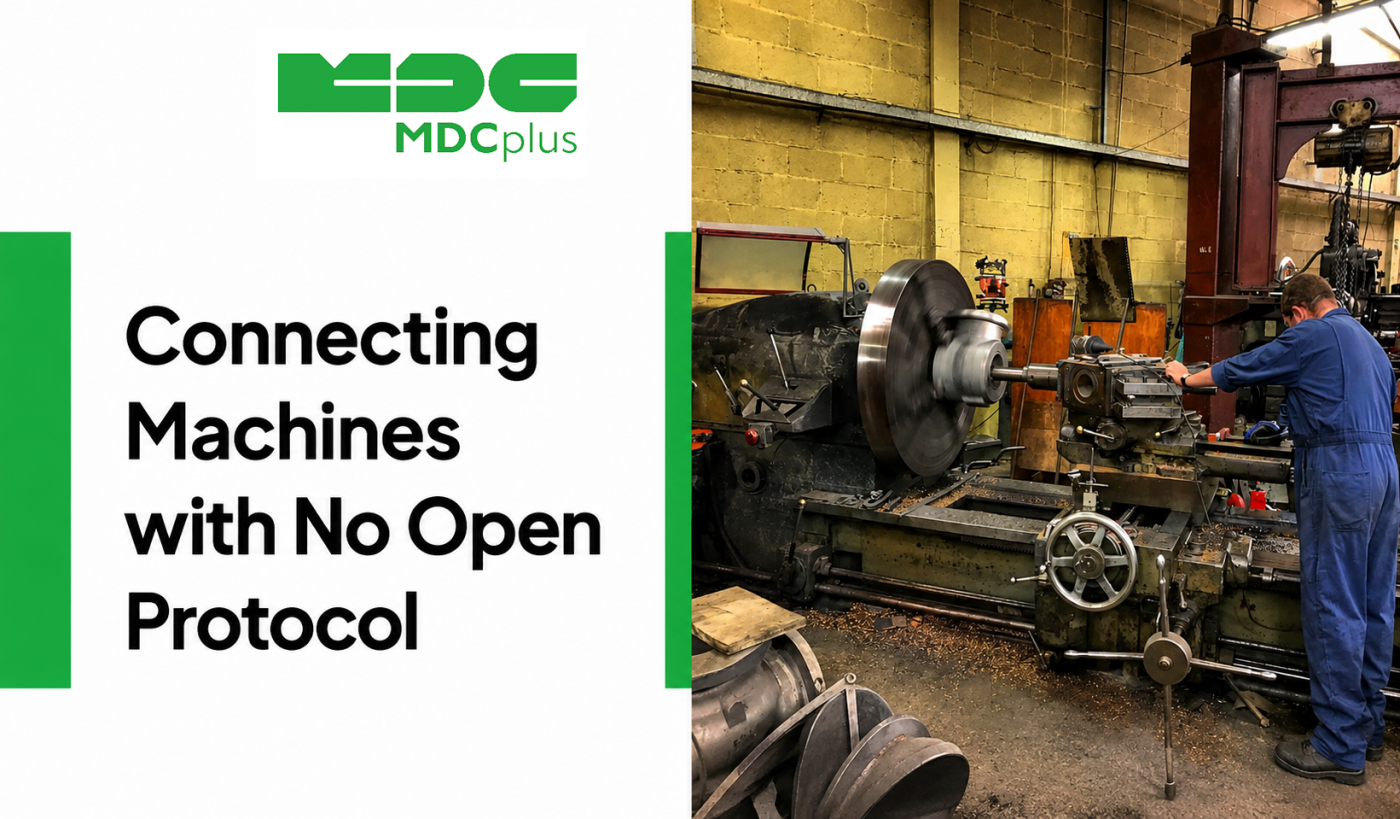
Most connectivity guides assume a machine speaks MTConnect, OPC UA, or a documented vendor protocol like FOCAS. In practice, a meaningful share of the equipment on a real shop floor doesn't — older CNC controllers, manual machines with no digital interface at all, or equipment where the manufacturer never opened up a data channel. This article covers what's actually possible when there's no open protocol to work with, and how to think about the trade-offs between the available approaches.
Contents:
- Why some machines have no open protocol
- Direct PLC access
- Signal-based and I/O monitoring
- External sensors: power, current, and vibration
- Vision-based reading of displays
- Trade-offs between approaches
- How MDCplus approaches machines without an open protocol
- Frequently asked questions
- Conclusion
Why some machines have no open protocol
It's a more common situation than it might seem, for a few different reasons:
- Age. Controllers built before open standards like MTConnect or OPC UA existed simply never implemented them, and retrofitting support isn't always offered by the original manufacturer.
- Non-CNC equipment. Injection molding machines, manual mills, older stamping presses, and various auxiliary equipment often have limited or no standardized digital interface, even on relatively recent units.
- Locked-down controllers. Some vendors restrict access to their proprietary interface behind licensing or hardware options that a shop may not have purchased, effectively leaving the machine without a practical open channel even though one technically exists at the protocol level.
- Discontinued or niche brands. Smaller or defunct CNC brands may never have built adapters for open standards, and no active developer community fills that gap the way it might for a major vendor.
Direct PLC access
Many CNC machines are built around an industrial PLC that controls or monitors much of the machine's behavior, even when the CNC controller itself has no open data interface. If the PLC is a common, well-documented model, it's often possible to read its memory directly — registers, coils, data blocks — using the PLC vendor's own communication protocol, without needing anything from the CNC controller manufacturer at all. This approach requires knowing (or reverse-engineering, with care) which memory addresses correspond to which machine states, which typically means working from the machine's ladder logic or PLC program documentation if available.
Signal-based and I/O monitoring
When neither the CNC controller nor the PLC offers accessible digital data, the next option is reading physical signals directly: contact closures, relay states, or digital I/O points that already exist on the machine for things like cycle-start lights, door interlocks, or spindle-on indicators. An external I/O module or edge device wired into these points can convert simple electrical signals into usable status data — running/stopped, in-cycle/idle — without touching the machine's control logic at all. It's a coarser picture than full protocol-based data (you typically get state changes, not detailed parameters), but it's often the only non-invasive option on genuinely closed equipment.
External sensors: power, current, and vibration
Where even I/O access isn't practical, external sensors attached to the machine from the outside can infer state indirectly:
- Current or power sensors clamped onto a machine's electrical supply can distinguish idle, running, and off states based on power draw patterns, without any connection to the control system.
- Vibration sensors can detect whether a spindle or axis is actually moving, which is useful for confirming real cycle activity versus a machine that's powered on but not producing.
These methods don't give you program names, part counts, or specific parameter values — they give you inferred operational state, which is still enough to calculate meaningful availability and utilization metrics on equipment that would otherwise contribute nothing to a monitoring system.
Vision-based reading of displays
On some closed controllers, the only practical option is reading what's already shown on the machine's own screen: a camera pointed at the display, paired with software that recognizes specific fields (program number, alarm state, cycle count) through image processing. This is more fragile than any of the previous approaches — it depends on consistent lighting, screen visibility, and a display layout that doesn't change with firmware updates — but it can be the only non-invasive path on genuinely closed, undocumented equipment.
Trade-offs between approaches
| Approach | Data depth | Invasiveness | Typical cost |
|---|---|---|---|
| Direct PLC access | High — whatever is mapped in the PLC program | Low to moderate | Low, if PLC is well documented |
| Signal/I/O monitoring | Low — state changes only | Low | Low |
| Power/vibration sensors | Low — inferred state | Very low, fully external | Low to moderate |
| Vision-based reading | Moderate, but fragile | Very low, fully external | Moderate, ongoing maintenance |
None of these approaches is universally "best" — the right choice depends on what data you actually need, how invasive a solution the machine and its warranty terms allow, and how much ongoing maintenance is acceptable.
How MDCplus approaches machines without an open protocol
This is exactly the situation MDCplus's connector library is built to handle. Rather than requiring every machine to support a specific open standard, MDCplus maintains a broad library of connection methods — covering major CNC brands' proprietary protocols, PLC-level access, and hardware-based signal and sensor monitoring — so that machines without any open protocol can still be brought into the same monitoring platform as everything else, instead of being left out of the picture entirely.
If you're not sure whether a specific machine can be connected, the practical way to find out is to check it directly: use the Can I Connect This Machine tool to see which connection method applies to your equipment before assuming it can't be monitored at all.
Frequently asked questions
Is it always possible to get some data from a machine, even a very old one?
In most cases, yes — even machines with no digital interface at all can usually be monitored at a basic level through external power or vibration sensors, since those don't depend on anything the machine itself exposes. The level of detail available varies significantly depending on the equipment.
Does connecting through the PLC void a machine's warranty?
It depends on the manufacturer, the machine's age, and how the connection is made. Reading PLC data without modifying the program is generally lower-risk than altering control logic, but it's worth checking warranty terms and, where relevant, consulting the machine builder before making changes to a machine still under warranty.
How accurate is power or vibration-based monitoring compared to protocol-based data?
It's less precise — these methods typically infer running/idle/stopped state rather than reading exact parameters like program name or part count — but for calculating basic availability and utilization metrics, inferred state is often sufficient, especially when it's the only option available.
Can a machine with no open protocol still be added to a dashboard alongside modern, protocol-connected machines?
Yes. A monitoring platform that supports multiple connection methods can normalize data from PLC access, signal monitoring, and modern protocols like MTConnect or OPC UA into the same dashboard, so the connection method a specific machine uses doesn't need to be visible to whoever is reading the reports.
Conclusion
Not having an open protocol doesn't mean a machine can't be monitored — it means the connection has to happen at a different layer, whether that's the PLC, raw I/O signals, external sensors, or even a camera on the display. The right approach depends on what data you actually need and how invasive a solution makes sense for that specific machine. Before assuming a piece of equipment is a dead end for monitoring, it's worth checking what's actually possible rather than ruling it out based on the absence of a documented protocol.
Related articles:
- Can I Connect This Machine?
- Direct Connection: CNC-PLC Data Collection
- PLC Data Collection: Your Bridge from Tradition to Tomorrow
- MTConnect Explained: How the Manufacturing Data Standard Works
- MDCplus Machine Connectivity & Integrations
About MDCplus
Our key features are real-time machine monitoring for swift issue resolution, power consumption tracking to promote sustainability, computerized maintenance management to reduce downtime, and vibration diagnostics for predictive maintenance. MDCplus's solutions are tailored for diverse industries, including aerospace, automotive, precision machining, and heavy industry. By delivering actionable insights and fostering seamless integration, we empower manufacturers to boost Overall Equipment Effectiveness (OEE), reduce operational costs, and achieve sustainable growth along with future planning.
Ready to increase your OEE, get clearer vision of your shop floor, and predict sustainably?
Other articles
14.08.2026
How Do You Build a Mobile Dashboard Plant Managers Actually Use?
Building a mobile-first Tailwind PWA for plant managers: what belongs on a phone screen, offline behavior, push notifications, and prompts for an executive manufacturing dashboard
Read more
13.08.2026
How Do You Create Manufacturing KPI Widgets with Cursor and v0.dev?
Using v0.dev to generate manufacturing KPI widgets and Cursor to wire them into an existing dashboard repo: the two-tool workflow, prompts for scrap rate and MTTR/MTBF, and integration pitfalls
Read more
12.08.2026
How Do You Build a 3D Shop Floor Map Driven by Live PLC Data?
Building a 3D shop floor map with React Three Fiber: preparing CAD geometry for the web, mapping PLC tags to mesh colors, performance limits, and when 3D is the wrong choice.
Read more
11.08.2026
How Do You Design an Andon Display For Shop-Floor Using AI?
Prompting UI/UX for shop floor Andon displays: type scale for distance viewing, colorblind-safe status coding, glare and glove constraints, and prompts that produce factory-ready screens
Read more
10.08.2026
How Do You Get Live OPC UA Machine Data into Retool?
How to vibe-code a Retool custom component that streams live OPC UA machine data over WebSockets: the bridge service, security boundaries, and prompts for each layer
Read more