Make production transparent. Try MDCplus
Try it yourself Get guided demo24 July 2026
ETL Pipelines for Machine Data
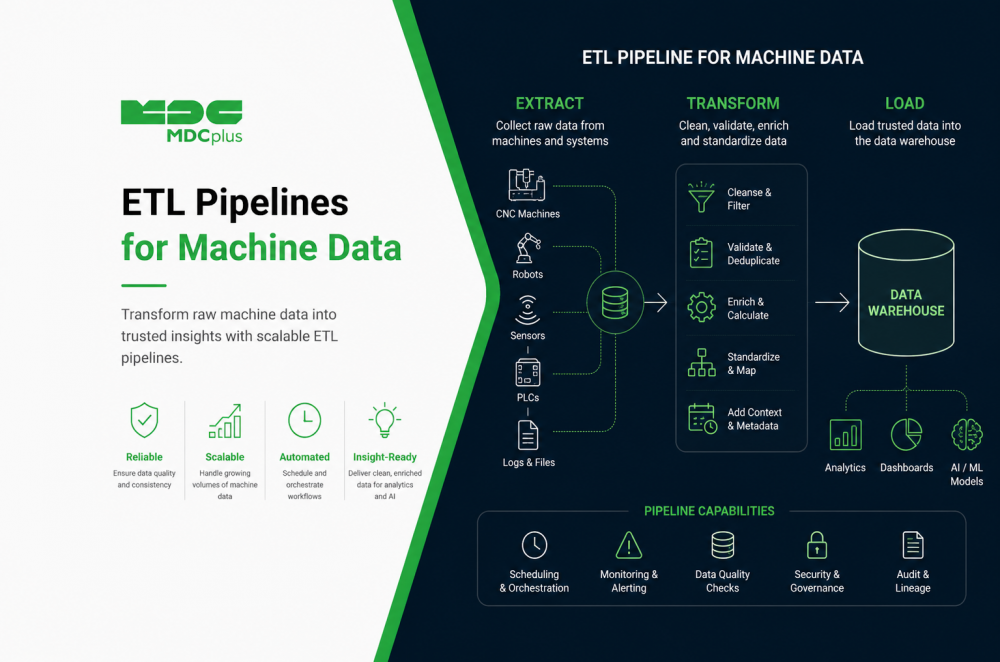
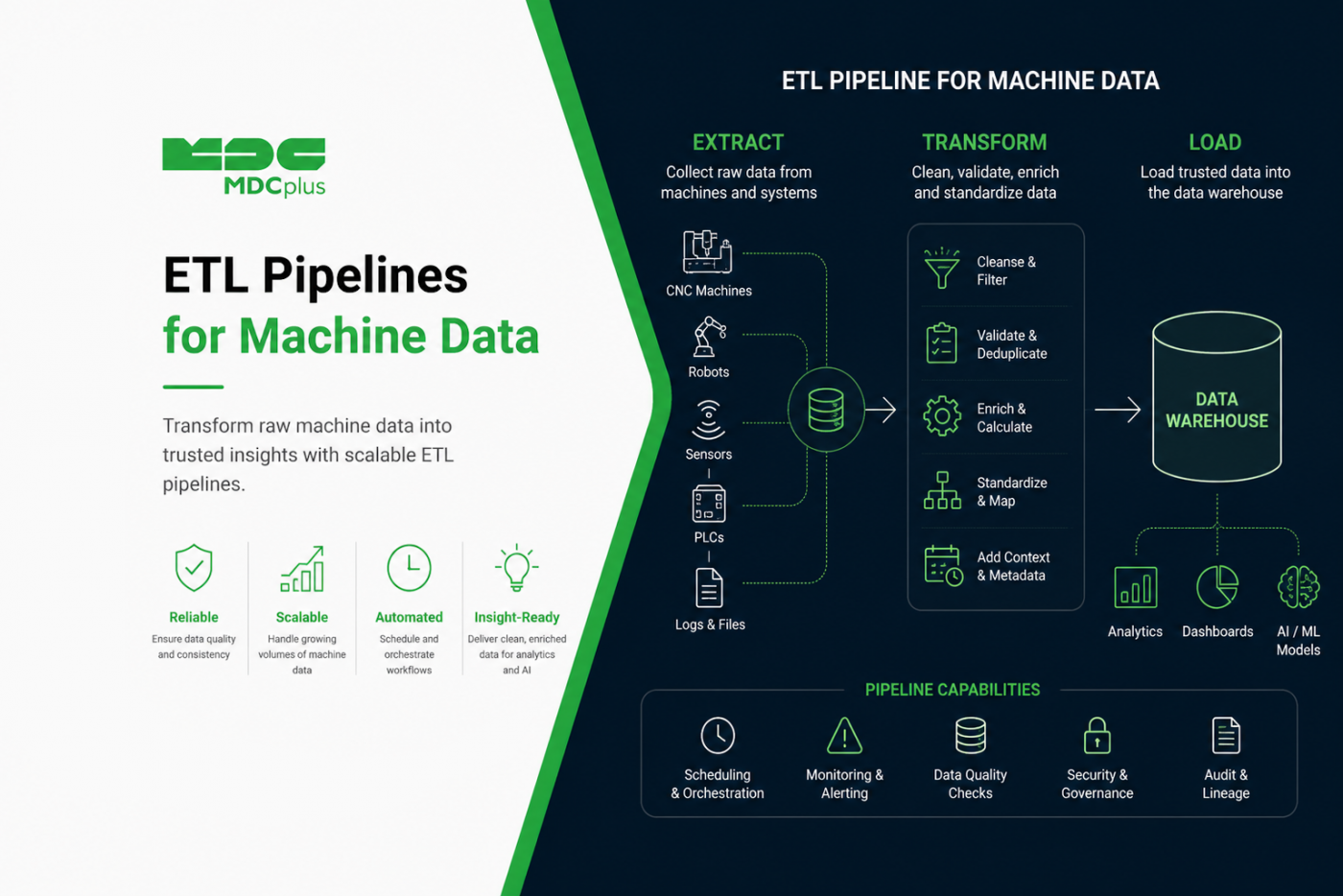
How ETL pipelines work for machine data: extracting from different sources, transforming raw signals into usable data, loading into storage, and ETL vs ELT difference
How to make machine data usable?
Getting machine data from where it's generated to where it's actually usable almost always involves some form of ETL — extract, transform, load. This article covers what each of those three stages actually looks like for machine data specifically, since it differs in a few important ways from typical business ETL work. For a comparison of ready-made ETL tools, our roundup of free ETL and database management systems covers the tool landscape; this article focuses on the pipeline design itself, independent of which specific tool implements it.
Contents:
- What ETL means for machine data
- Extract: pulling from machine data sources
- Transform: turning raw signals into usable data
- Load: getting data into its destination
- ETL vs. ELT
- Batch vs. streaming ETL
- Practical pipeline design considerations
- Common pitfalls
- Frequently asked questions
- Conclusion
What ETL means for machine data
ETL stands for Extract, Transform, Load — the three-stage process of pulling data from a source, reshaping it into a usable form, and depositing it into a destination system. For machine data, this typically means: extracting signals from CNC controllers, PLCs, or sensors; transforming raw readings into meaningful states and metrics; and loading the result into a database, data lake, or another system for storage and analysis. The general concept is the same as ETL in any other domain, but the specifics of each stage look different when the source is a machine rather than, say, a CRM export.
Extract: pulling from machine data sources
This stage overlaps heavily with the connectivity topics covered elsewhere on this blog — reading data via MTConnect, OPC UA, vendor-specific protocols like FOCAS, or signal-based methods for machines without an open protocol. What matters at the ETL level is less the specific protocol and more how consistently and reliably extraction happens: whether it's continuous, scheduled, or triggered by events, and how the pipeline handles a source that's temporarily unreachable. Our data acquisition architecture overview covers this connection layer in more depth.
Transform: turning raw signals into usable data
This is usually the most involved stage for machine data specifically, and it overlaps with what we cover in from raw signals to useful metrics: applying thresholds to interpret raw values, detecting and timing machine states, filtering noise, and calculating derived metrics. For an ETL pipeline feeding a broader system (rather than a dedicated monitoring platform's own internal logic), transformation often also includes:
- Unit and format normalization — converting different machines' native units or formats into a consistent standard before loading.
- Joining with other data sources — combining machine telemetry with quality records, job/work-order data, or shift schedules to produce a more complete picture than machine data alone provides.
- Deduplication — removing duplicate records that can arise from retry logic or overlapping extraction windows.
- Schema mapping — reshaping source-specific field names and structures into the destination's expected schema, covered in more detail in our piece on designing a machine data schema for analytics.
Load: getting data into its destination
Where transformed data ends up depends on how it will be used:
- A time-series database, when the primary use case is querying machine telemetry by time range — compared directly against relational storage in our SQL vs. time-series database piece.
- A data lake, when machine data needs to sit alongside other, differently-structured sources for broader analysis, covered in pushing shop floor data into a data lake.
- A data warehouse or BI-ready store, when the destination is primarily business reporting rather than raw analytical flexibility.
- Directly into another operational system, such as an ERP or MES, when the goal is feeding a specific business process rather than general-purpose storage.
ETL vs. ELT
ELT (Extract, Load, Transform) reorders the process: raw data is loaded into the destination first, and transformation happens afterward, typically using the destination system's own processing power. This has become more common with the rise of data lakes and cloud data warehouses capable of handling large-scale transformation internally. For machine data, ELT can make sense when you want to preserve maximum raw fidelity before deciding on transformation logic, or when the same raw data needs to support multiple different transformations for different downstream uses. Traditional ETL remains preferable when transformation needs to happen close to the source, or when the destination system isn't well suited to heavy processing itself.
Batch vs. streaming ETL
Batch ETL processes data in scheduled chunks — hourly, nightly — suited to use cases where some delay between an event and its availability downstream is acceptable. Streaming ETL processes data continuously as it arrives, often built around a message-based pattern like MQTT feeding a continuous transformation pipeline, better suited to use cases needing near-real-time visibility. Many manufacturers use both: streaming for time-sensitive alerts and dashboards, batch for heavier, less time-critical reporting and historical analysis.
Practical pipeline design considerations
- Idempotency. A pipeline that can safely reprocess the same data without creating duplicates is far easier to recover from failures with, compared to one where every retry risks double-counting.
- Error handling and dead-letter queues. Records that fail transformation shouldn't simply be dropped silently; routing them somewhere reviewable prevents quiet, undetected data loss.
- Monitoring the pipeline itself. An ETL pipeline that silently stops running is its own data quality problem; alerting on pipeline failures, not just on the data it produces, closes that gap.
- Versioning transformation logic. As covered in our piece on raw signals to metrics, changes to thresholds or calculation rules affect historical comparability; tracking when transformation logic changed helps explain shifts in reported metrics later.
Common pitfalls
- Building transformation logic that can't be audited. If it's unclear what rules were applied to produce a given value, troubleshooting an unexpected number becomes guesswork.
- Treating extraction as fire-and-forget. Assuming a scheduled extraction job always succeeds, without monitoring for silent failures, is a common way gaps go unnoticed for a long time.
- Over-engineering for scale that doesn't exist yet. A complex, highly distributed pipeline built for a handful of machines adds maintenance overhead disproportionate to the actual data volume.
- Ignoring schema drift. A source system change (a new field, a renamed signal) that isn't caught can silently break downstream transformation logic or produce incomplete records.
Frequently asked questions
Do I need a dedicated ETL tool, or can this be built with custom scripts?
Both approaches are common. Simple, low-volume pipelines are sometimes handled with custom scripts; larger or more complex pipelines generally benefit from a dedicated ETL tool's built-in scheduling, error handling, and monitoring capabilities rather than reimplementing those features from scratch.
Should transformation happen before or after loading into storage?
This is the ETL vs. ELT question covered above — it depends on whether the destination system can handle transformation efficiently and whether you want to preserve untransformed raw data for flexibility. Neither approach is universally correct.
How does an ETL pipeline handle a machine that goes offline temporarily?
A well-designed pipeline should distinguish "no data because the source was unreachable" from "no data because nothing happened," logging the gap explicitly rather than silently treating a missing extraction as equivalent to a real absence of activity.
Is ETL still relevant if I'm using a managed monitoring platform?
Often yes, particularly when data needs to move beyond the monitoring platform itself into a data lake, warehouse, or other business system. The platform typically handles its own internal data processing, but getting that data into other places for broader analysis usually still involves some form of ETL.
Conclusion
ETL for machine data follows the same three-stage logic as ETL anywhere else, but each stage has specifics worth understanding: extraction depends heavily on machine connectivity methods, transformation involves the same signal-to-metric logic covered elsewhere on this blog plus normalization and joining with other sources, and loading depends on what the destination is actually meant to support. Getting the pipeline design right — idempotent, monitored, and versioned — matters more for long-term reliability than which specific tool implements it.
Related articles:
- Top Free ETL & Database Management Systems for Industrial Data
- From Raw Signals to Useful Metrics
- How to Push Shop Floor Data into a Data Lake
- Streaming Machine Data with MQTT
- MDCplus Machine Connectivity & Integrations
About MDCplus
Our key features are real-time machine monitoring for swift issue resolution, power consumption tracking to promote sustainability, computerized maintenance management to reduce downtime, and vibration diagnostics for predictive maintenance. MDCplus's solutions are tailored for diverse industries, including aerospace, automotive, precision machining, and heavy industry. By delivering actionable insights and fostering seamless integration, we empower manufacturers to boost Overall Equipment Effectiveness (OEE), reduce operational costs, and achieve sustainable growth along with future planning.
Ready to increase your OEE, get clearer vision of your shop floor, and predict sustainably?
Other articles
14.08.2026
How Do You Build a Mobile Dashboard Plant Managers Actually Use?
Building a mobile-first Tailwind PWA for plant managers: what belongs on a phone screen, offline behavior, push notifications, and prompts for an executive manufacturing dashboard
Read more
13.08.2026
How Do You Create Manufacturing KPI Widgets with Cursor and v0.dev?
Using v0.dev to generate manufacturing KPI widgets and Cursor to wire them into an existing dashboard repo: the two-tool workflow, prompts for scrap rate and MTTR/MTBF, and integration pitfalls
Read more
12.08.2026
How Do You Build a 3D Shop Floor Map Driven by Live PLC Data?
Building a 3D shop floor map with React Three Fiber: preparing CAD geometry for the web, mapping PLC tags to mesh colors, performance limits, and when 3D is the wrong choice.
Read more
11.08.2026
How Do You Design an Andon Display For Shop-Floor Using AI?
Prompting UI/UX for shop floor Andon displays: type scale for distance viewing, colorblind-safe status coding, glare and glove constraints, and prompts that produce factory-ready screens
Read more
10.08.2026
How Do You Get Live OPC UA Machine Data into Retool?
How to vibe-code a Retool custom component that streams live OPC UA machine data over WebSockets: the bridge service, security boundaries, and prompts for each layer
Read more