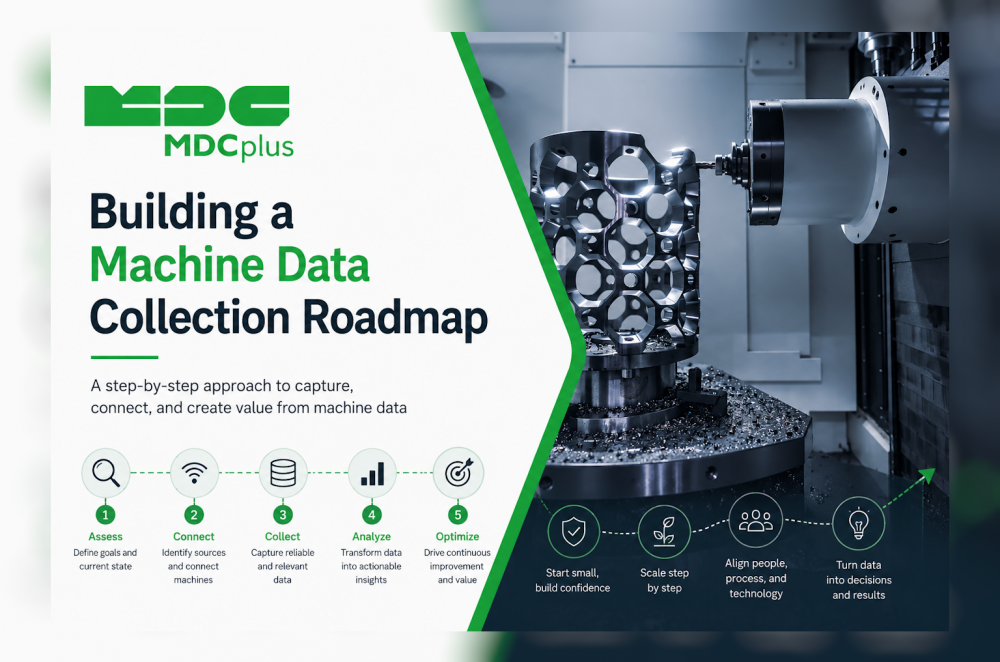
At MDCplus, we help to build and execute your roadmap
Try it yourself Get guided demo02 July 2026
Building a Machine Data Collection Roadmap
A practical, phased roadmap for a machine data collection project: defining objectives, prioritizing machines, choosing connection methods, and scaling from pilot to full fleet
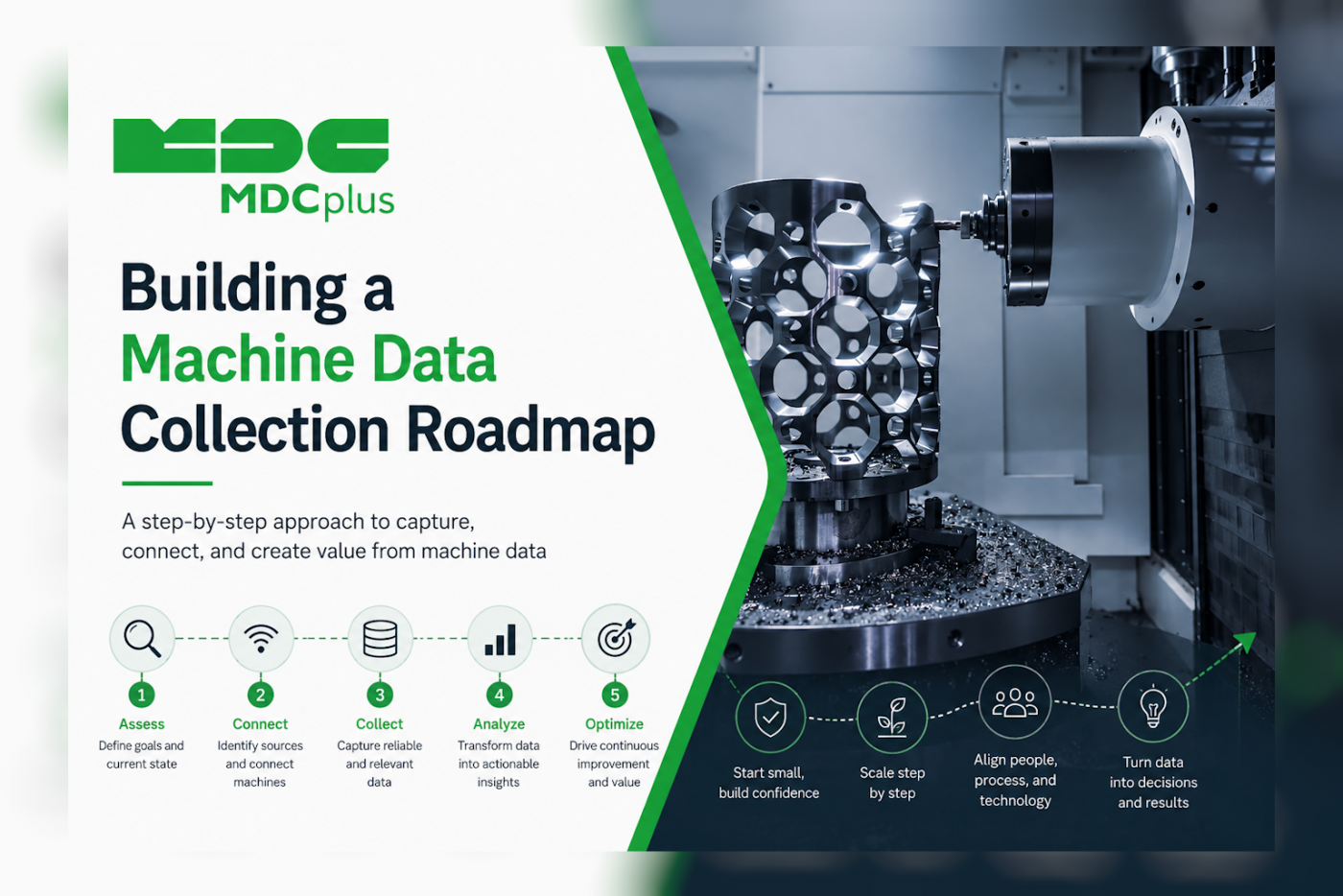
Where should I start?
Most of this section has covered individual pieces of a data collection project — architecture, connection methods, signals, sampling, quality. This article ties them together into an actual sequence: how to plan a real project from "we should probably monitor our machines" to a working, trusted system across the fleet. A roadmap doesn't need to be complicated, but skipping the planning step entirely is one of the most common reasons data collection projects stall or produce data nobody trusts.
Contents:
- Why a roadmap matters
- Phase 1: Define what questions the data needs to answer
- Phase 2: Inventory and prioritize machines
- Phase 3: Choose connection methods
- Phase 4: Define signals, sampling, and metric logic
- Phase 5: Plan the network and security
- Phase 6: Pilot and validate
- Phase 7: Scale and iterate
- Common roadmap mistakes
- Frequently asked questions
- Conclusion
Why a roadmap matters
Without a deliberate sequence, data collection projects tend to start with whichever machine is easiest to connect, using whatever protocol the vendor happened to mention first, without a clear picture of what questions the resulting data is actually meant to answer. That approach can produce a technically working connection that nobody ends up trusting or using, because it wasn't built around an actual decision it needs to support. A roadmap fixes the order of operations: understand the goal before picking a machine, understand the machine before picking a protocol, and validate before scaling.
Phase 1: Define what questions the data needs to answer
Before touching a single machine, get specific about what the data is actually for: reducing unplanned downtime, calculating accurate OEE, feeding a customer-facing production dashboard, catching quality issues earlier. Different goals point toward different priorities — a downtime-reduction project cares most about accurate Availability signals and reason codes; a predictive maintenance goal cares about high-frequency vibration data that a basic OEE project doesn't need at all. If you're newer to the topic generally, our data collection primer is a good starting point before this phase.
Phase 2: Inventory and prioritize machines
List every machine that's a candidate for connection, along with basic facts: controller brand and model, approximate age, and how central it is to the bottleneck or process the project cares about. Prioritize by a combination of business value (is this a bottleneck machine, a high-cost asset) and ease of connection (does it already support a modern protocol, or will it need PLC-level or sensor-based methods). Starting with a small number of high-value, reasonably easy-to-connect machines is almost always a better sequence than either "the easiest machines regardless of value" or "every machine at once."
Phase 3: Choose connection methods
For each prioritized machine, determine the right connection approach — direct protocol connection where supported, a terminal for context data, or sensor-based monitoring for equipment with no practical alternative, as covered in our comparison of direct connection, terminal, and sensor-based methods. For the technical side of protocol selection specifically, the architecture behind it is covered in CNC data acquisition basics, and machines with no usable protocol at all are addressed in connecting machines with no open protocol.
Phase 4: Define signals, sampling, and metric logic
With connections planned, define exactly which signals matter for the goals set in Phase 1 — our breakdown of machine signals for OEE is a good reference if that's the driving metric. Decide on sampling rates deliberately rather than defaulting to one interval everywhere, as covered in sampling rate and granularity, and define the thresholds and aggregation logic that will turn raw signals into metrics, per from raw signals to useful metrics. Documenting these decisions at this stage, rather than after the fact, makes later troubleshooting and cross-machine comparison significantly easier.
Phase 5: Plan the network and security
Before deploying anything, confirm the network can actually support the planned connections — IT/OT segmentation, IP addressing, and access control, covered in more depth in shop floor network setup. This is a common point where projects that looked straightforward on paper hit real delays, since network changes often involve a different team or approval process than the monitoring project itself; flagging this dependency early avoids it becoming a late-stage surprise.
Phase 6: Pilot and validate
Roll out to the prioritized pilot machines first, and deliberately validate before trusting the results: check for the missing data, misconfigured thresholds, and timestamp problems covered in data quality on the shop floor. Compare early metrics against what people on the floor already know to be true — if the numbers don't match intuition, that's worth investigating before scaling the same configuration to more machines.
Phase 7: Scale and iterate
Once the pilot is validated and genuinely trusted by the people using it, extend the same approach to the next tier of machines, reusing what worked and adjusting what didn't. Treat the roadmap as a living plan rather than a one-time document: new machines get added, priorities shift as goals evolve, and configuration occasionally needs revisiting as controllers are upgraded or replaced.
Common roadmap mistakes
- Starting with every machine at once. A big-bang rollout multiplies the number of things that can go wrong simultaneously and makes it much harder to isolate the cause when something does.
- No defined pilot or validation step. Moving straight from setup to full production trust skips the point where data quality problems are cheapest to catch and fix.
- Choosing protocol before purpose. Deciding "we'll use OPC UA everywhere" before understanding what data each machine and goal actually needs often leads to either over-engineering or missing critical signals.
- Ignoring the people side. A roadmap focused only on technical steps, without planning how operators will interact with terminals or how managers will actually use the resulting reports, risks a technically successful project that doesn't change anything operationally.
- No documentation as the project scales. Configuration decisions that made sense to whoever set up the first three machines can become impossible to reconstruct once a dozen more machines and turnover have happened, unless they're written down along the way.
Frequently asked questions
How long should a pilot phase last before scaling?
There's no fixed answer, but a pilot should run long enough to see a representative range of normal operation — typically a few weeks at minimum — and long enough for the people who'll use the data to actually review it and flag anything that looks wrong before it's replicated across more machines.
How many machines should a pilot include?
Enough to represent the variety in the fleet (different controller brands, ages, or criticality levels) without being so large that troubleshooting problems becomes difficult. A handful of representative machines is usually more useful than either a single machine or the entire fleet at once.
Should the roadmap be built by IT, operations, or both?
Both, ideally. Operations typically owns the questions the data needs to answer and understands the machines; IT or an OT-focused team typically owns network and security planning. Projects that involve only one side tend to either produce data nobody operational trusts or a network setup that creates security gaps.
What's the biggest predictor of whether a data collection project actually gets used?
Whether Phase 1 was done properly — if the data collected genuinely answers a real question someone had, it tends to get used; if the project started from "let's connect some machines" without a clear question in mind, the resulting dashboards often go unused regardless of how technically sound the connection work was.
Conclusion
A machine data collection project succeeds or fails less on protocol choice and more on sequence: knowing what questions the data needs to answer before choosing machines, choosing machines before choosing connection methods, and validating before scaling. Every phase in this roadmap connects back to a more detailed piece elsewhere in this section — the point of the roadmap is putting them in the right order for an actual project, not repeating the technical detail already covered.
Related articles:
- How Not to Implement Digital Data Collection in Manufacturing
- Data Collection for Beginners
- CNC Data Acquisition: Architecture Basics
- Data Quality on the Shop Floor: Common Pitfalls
- MDCplus Machine Connectivity & Integrations
About MDCplus
Our key features are real-time machine monitoring for swift issue resolution, power consumption tracking to promote sustainability, computerized maintenance management to reduce downtime, and vibration diagnostics for predictive maintenance. MDCplus's solutions are tailored for diverse industries, including aerospace, automotive, precision machining, and heavy industry. By delivering actionable insights and fostering seamless integration, we empower manufacturers to boost Overall Equipment Effectiveness (OEE), reduce operational costs, and achieve sustainable growth along with future planning.
Ready to increase your OEE, get clearer vision of your shop floor, and predict sustainably?
Other articles
14.08.2026
How Do You Build a Mobile Dashboard Plant Managers Actually Use?
Building a mobile-first Tailwind PWA for plant managers: what belongs on a phone screen, offline behavior, push notifications, and prompts for an executive manufacturing dashboard
Read more
13.08.2026
How Do You Create Manufacturing KPI Widgets with Cursor and v0.dev?
Using v0.dev to generate manufacturing KPI widgets and Cursor to wire them into an existing dashboard repo: the two-tool workflow, prompts for scrap rate and MTTR/MTBF, and integration pitfalls
Read more
12.08.2026
How Do You Build a 3D Shop Floor Map Driven by Live PLC Data?
Building a 3D shop floor map with React Three Fiber: preparing CAD geometry for the web, mapping PLC tags to mesh colors, performance limits, and when 3D is the wrong choice.
Read more
11.08.2026
How Do You Design an Andon Display For Shop-Floor Using AI?
Prompting UI/UX for shop floor Andon displays: type scale for distance viewing, colorblind-safe status coding, glare and glove constraints, and prompts that produce factory-ready screens
Read more
10.08.2026
How Do You Get Live OPC UA Machine Data into Retool?
How to vibe-code a Retool custom component that streams live OPC UA machine data over WebSockets: the bridge service, security boundaries, and prompts for each layer
Read more