Make production transparent. Try MDCplus
Try it yourself Get guided demo20 July 2026
Edge vs Cloud Data Collection: Trade-offs
The real trade-offs between edge and cloud data collection for machine monitoring: latency, bandwidth, offline resilience, cost, and security, with a practical decision framework
Is Edge better than Cloud?
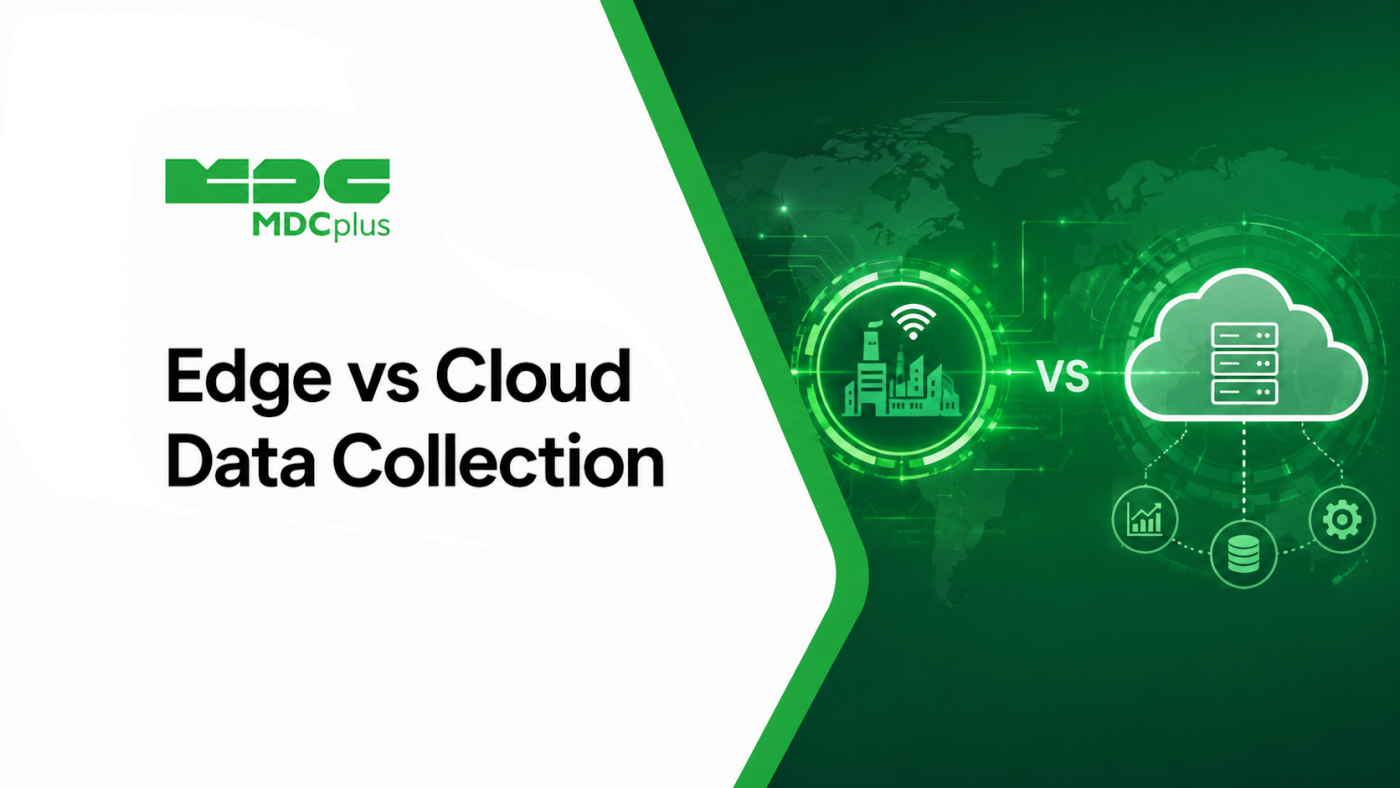
"Edge vs cloud" gets framed as a binary choice more often than it deserves to be. In practice, it's less about picking one and more about deciding which specific pieces of the data pipeline should run close to the machine versus further away, in a data center or cloud platform. This article breaks down the real trade-offs — not as a philosophical debate, but as a set of practical questions that determine where processing should actually happen for a given signal or use case.
Contents:
- What "edge" and "cloud" mean here
- Latency and bandwidth
- Offline resilience
- Cost considerations
- Security and data control
- The hybrid reality
- A practical decision framework
- Frequently asked questions
- Conclusion
What "edge" and "cloud" mean here
Edge refers to computing that happens physically close to the machine — a local device or server on the plant network, sometimes a small industrial PC sitting right next to the equipment it monitors. Cloud refers to computing that happens on infrastructure hosted elsewhere, typically accessed over the internet. This article is specifically about where data processing happens during collection — not about whether the monitoring software itself is delivered as a cloud product, which is a related but distinct decision covered in do you need a cloud for your monitoring software. A cloud-hosted monitoring platform can still rely heavily on edge processing for data collection, and an on-premise platform can still send some data offsite; the architecture question and the software delivery question don't have to move together.
Latency and bandwidth
Edge processing keeps data close, which minimizes the delay between something happening on a machine and a system reacting to it — relevant for use cases like real-time alerts or anything that needs to respond within seconds. It also reduces the volume of data that has to travel over the network to a remote destination, since raw high-frequency data can be filtered, aggregated, or summarized locally before only the meaningful result is sent onward. Cloud-only architectures, where every raw reading travels immediately to a remote destination, tend to use more bandwidth and introduce more latency, which matters more for some use cases (real-time control-adjacent alerts) than others (daily trend reporting, where a few seconds or minutes of delay is irrelevant).
Offline resilience
Internet or WAN connectivity to a cloud platform isn't always continuously available — and even brief outages, common on real industrial networks, can create gaps in a purely cloud-dependent architecture. Edge components that can locally buffer data during an outage and forward it once connectivity resumes prevent those gaps from becoming permanent data loss. This matters more for manufacturers in locations with less reliable internet infrastructure, or where even short data gaps meaningfully affect trust in reported metrics.
Cost considerations
Edge hardware has an upfront and maintenance cost — devices to purchase, install, and keep updated across potentially many machines. Cloud processing and storage typically come with ongoing usage-based costs that scale with data volume, which can become significant if large amounts of raw, unfiltered data are transmitted and stored without any local reduction first. In practice, a reasonable amount of edge-side filtering or aggregation often reduces cloud costs meaningfully, which is one of the more concrete financial arguments for at least some edge processing even in an otherwise cloud-centric architecture.
Security and data control
Keeping more processing at the edge means less raw data leaving the plant network in the first place, which some manufacturers prefer for security or data governance reasons, particularly in industries with stricter compliance requirements or for machines whose data is considered especially sensitive. This isn't an argument against cloud platforms generally — reputable cloud providers invest heavily in security — but rather a reminder that minimizing what leaves the plant network is a legitimate design consideration independent of how trustworthy the destination is. As covered in our shop floor network setup guide, how data moves between OT and IT/cloud segments is a security decision in its own right, regardless of where final processing happens.
The hybrid reality
Very few real deployments are purely edge or purely cloud. A typical architecture uses edge components for protocol translation, local buffering, and basic filtering or aggregation, while relying on the cloud (or a central on-premise server) for longer-term storage, cross-machine analysis, and dashboards accessible from outside the plant. The question in practice usually isn't "edge or cloud" but "which specific stages of the pipeline belong where," which connects directly to the broader architecture covered in our data acquisition architecture overview.
A practical decision framework
- Favor edge processing when latency matters. Real-time alerting or anything time-sensitive benefits from processing close to the source rather than waiting on a round trip to a remote destination.
- Favor edge buffering when connectivity is unreliable. Locations with inconsistent internet access need local resilience regardless of where final storage lives.
- Favor edge filtering when data volume or cost is a concern. High-frequency signals (like vibration data) are strong candidates for local aggregation before transmission.
- Favor cloud for cross-plant visibility and long-term storage. Comparing performance across multiple facilities, or retaining years of historical trend data, is naturally suited to centralized storage rather than isolated local systems.
- Don't treat it as all-or-nothing. Most manufacturers get the best outcome by deliberately assigning each stage of the pipeline to wherever it makes the most sense, rather than committing entirely to one architecture.
Frequently asked questions
Do I need edge hardware if I'm using a cloud-based monitoring platform?
Not necessarily for a small deployment with reliable connectivity, but many cloud-based platforms still use a lightweight edge component for protocol translation and local buffering, since it improves resilience without requiring the manufacturer to manage the cloud infrastructure itself.
Is edge computing more secure than cloud by default?
Not automatically — both approaches can be implemented securely or insecurely. Edge processing reduces the volume of raw data leaving the plant network, which is a genuine consideration, but cloud platforms with proper security practices aren't inherently less safe.
Does a hybrid edge-cloud approach cost more than choosing just one?
It can involve more upfront components (edge hardware plus cloud services) than a purely cloud-only setup, but often costs less overall once you account for reduced data transmission and storage volume from edge-side filtering, along with better resilience against connectivity issues.
How does this decision interact with network setup?
Closely — edge components typically sit on the local OT network and need a controlled path to reach cloud or central storage, which is exactly the kind of segmented, deliberate connection covered in shop floor network design rather than an open, unrestricted link.
Conclusion
Edge and cloud aren't competing philosophies so much as different tools suited to different stages of the same pipeline. Real-time responsiveness, offline resilience, and data volume reduction favor edge processing; long-term storage, cross-site visibility, and centralized analysis favor the cloud. Most manufacturers end up somewhere in between, and the useful question isn't which side to pick, but which specific piece of the pipeline belongs where.
Related articles:
- Do You Need a Cloud for Your Monitoring Software?
- CNC Data Acquisition: Architecture Basics
- Shop Floor Network Setup for Machine Monitoring
- Sampling Rate and Data Granularity Explained
- MDCplus Machine Connectivity & Integrations
About MDCplus
Our key features are real-time machine monitoring for swift issue resolution, power consumption tracking to promote sustainability, computerized maintenance management to reduce downtime, and vibration diagnostics for predictive maintenance. MDCplus's solutions are tailored for diverse industries, including aerospace, automotive, precision machining, and heavy industry. By delivering actionable insights and fostering seamless integration, we empower manufacturers to boost Overall Equipment Effectiveness (OEE), reduce operational costs, and achieve sustainable growth along with future planning.
Ready to increase your OEE, get clearer vision of your shop floor, and predict sustainably?
Other articles
14.08.2026
How Do You Build a Mobile Dashboard Plant Managers Actually Use?
Building a mobile-first Tailwind PWA for plant managers: what belongs on a phone screen, offline behavior, push notifications, and prompts for an executive manufacturing dashboard
Read more
13.08.2026
How Do You Create Manufacturing KPI Widgets with Cursor and v0.dev?
Using v0.dev to generate manufacturing KPI widgets and Cursor to wire them into an existing dashboard repo: the two-tool workflow, prompts for scrap rate and MTTR/MTBF, and integration pitfalls
Read more
12.08.2026
How Do You Build a 3D Shop Floor Map Driven by Live PLC Data?
Building a 3D shop floor map with React Three Fiber: preparing CAD geometry for the web, mapping PLC tags to mesh colors, performance limits, and when 3D is the wrong choice.
Read more
11.08.2026
How Do You Design an Andon Display For Shop-Floor Using AI?
Prompting UI/UX for shop floor Andon displays: type scale for distance viewing, colorblind-safe status coding, glare and glove constraints, and prompts that produce factory-ready screens
Read more
10.08.2026
How Do You Get Live OPC UA Machine Data into Retool?
How to vibe-code a Retool custom component that streams live OPC UA machine data over WebSockets: the bridge service, security boundaries, and prompts for each layer
Read more